Email not displaying correctly? View it in your
browser
|
 |
|
There is pressing demand for improved infrastructure in both developed and developing economies, for example on average vehicles cross structurally deficient bridges more than 188 Million times a day in the US.
Bridge owners and designers in Europe, US and India are becoming increasingly interested in the use of duplex stainless steel for the replacement, strengthening or renovation of bridge structures. SCI is at the heart of developing design rules for stainless steel bridges.
With support from stainless steel producers and manufacturers, Nancy Baddoo chairs the Working Group responsible for the stainless steel Eurocode, EN 1993-1-4. Work is currently underway revising and extending the stainless steel design rules as part of the preparation of the Second Generation Eurocodes, with many improvements which will be relevant to the design of bridge structures.
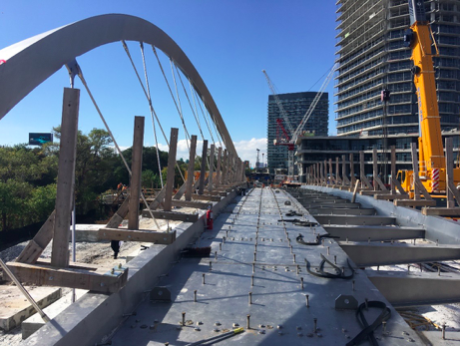
October saw the opening of the duplex stainless steel two-bridge Garrison Crossing in Toronto - designed using a combination of rules from the Eurocode and the American Institute of Steel Construction (AISC) Design Guide on structural stainless steel, written by SCI.
Francisco Meza and Nancy Baddoo have also been busy drafting the first AISC design specification for stainless steel structures. The rules will be aligned as far as possible with the AISC design rules for carbon steel, modified to suit the distinctive characteristics of stainless steel such as non-linear stress strain characteristics.
Closer to home, the new vehicle crossing at Pooley Bridge in Cumbria will be a stainless steel composite structure spanning 40 m and is due to open next year.
|
|
|
|
|
 |
Realising the Steel Design
10 Dec 19 - Webinar
|
|
|
Design of slimfloor composite beams
14 Jan 20 - Webinar
|
|
|
Steel Building Design to EC3 Course
30 Jan 20 - Birmingham
|
|
|
Light Gauge Steel Applications and Design
11 Feb 20 - Webinar
|
|
|
Steel Connection Design Course
12 Feb 20 - Webinar
|
|
|
View all courses
|
|
|
| SCI focusses on deconstruction and reuse.
|
|
Sustainable construction is currently riding up the agenda. Of the many challenges faced by the steel sector, greenhouse gas emissions and the urgency of addressing climate change, is arguably the biggest. Globally steel production accounts for around 7% of carbon emissions.
Many large steel makers have ambitious plans to develop and introduce new technologies to deliver 'zero carbon steel' but this will take time and a lot of investment and therefore we need to do what we can now to use and reuse steel construction products efficiently.
SCI has always focussed on the efficient use of steel in construction. More recently we have been working on ways to promote the reuse of structural steel and particularly how to design steel structures so that they can be deconstructed and reused in the future.
While we are very conscious of the challenges faced by the supply chain in reusing structural steel, we are also convinced that developing circular economy policy and the need to reduce carbon emissions will mandate reuse in the future. We need to think 'outside the box' and develop new business models to facilitate this.
SCI hosted a one-day event at the Building Centre in London on 8th October to present the findings from two EU-funded projects that are focussed on steel reuse and are nearing completion.
REDUCE, which is co-ordinated by SCI, is focussed on the development of demountable shear connection systems.
PROGRESS which focusses on the reuse and design for reuse, of single-storey steel buildings which are seen as the most easy to reuse steel structures.
Speakers from ten research partners across Europe presented the findings from both projects. The presentations freely available on the SCI website.
SCI also launched the new Structural steel reuse protocol (SCI P427) at the event. The protocol, which is underpinned by the work done under the PROGRESS project, gives recommendations on the assessment and testing of sections so that reclaimed structural steelwork can be used with confidence. The Protocol is freely available here.
|
 |
| UK Steel Construction Day 2019 review
|
|
This year's event was undoubtedly our most successful yet based on all key criteria. We had the highest attendance (almost 120), the lowest 'no show' rate, an excellent range of interesting and diverse presentations, supportive sponsors and a very 'user friendly' venue
Matthieu Mallié opened proceedings, straight off the Eurostar from Brussels, with an excellent and heavily pictorial presentation about the new bridge in Tintagel. His passion for the design was clear, as was the outstanding achievement of the bridge. We then had a number of presentations that, at one level, could highlight a dichotomy - does creating optimal solutions for a given structure represent the future, or does standardisation represent the future? The reality of course is a combination of the two - for certain building types standard solutions can be optimised and components potentially reused, other types are not suitable for standardisation but offer potentially bigger benefits from optimisation because of their more random nature. The extra steel used in a sub-optimal solution varies by structural form, but Mathew Gilbert showed us that common solutions may use two or three times more than the optimum requires. Accepting that minimum weight does not often represent minimum cost, knowing what could be achieved nevertheless provides a fascinating benchmark.
In parallel with the main session The Steel Piling Group held its flagship event, which was well received with over 40 delegates giving a combined total of 160 for the day. The event titled 'Innovative steel piling solutions' comprised a varied line up of speakers both from academia and industry. Presentations covered developments in the second generation of Eurocode EN 1993-5 (covering steel piling), novel advances in hydraulic piling hammers, and a case study describing sheet pile solutions for the Boston Barrier project.
If you weren't there you definitely missed something!
|

|
XII - Conference on Steel and Composite Construction,
in Coimbra, Portugal
|
|
The Steel Construction Institute (SCI) attended the XII - Conference on Steel and Composite Construction, in Coimbra, Portugal, organized by the Portuguese Steel and Composite Construction Association (CMM).
The main objective of the conference was to disseminate innovations and new achievements for Steel and Composite Construction. SCI staff contributed to the edition special theme "Steel Structures as the Answer to the Climatic Changes", for which Michael Sansom, Ana Giráo and Ricardo Pimentel made presentations about provisions for greater steel reuse. The SCI is also pleased that their new publication P427 - Structural Steel Reuse is getting noticed by the industry. The keynote speaker and RIBA member Cezary Bednarski described the publication as an important step forward to achieve a more sustainable built environment. SCI staff member Ricardo Pimentel was also awarded with a distinction for one of the best 6 papers in the conference with his paper on "Design for structural stability according to Eurocode 3: fundamentals and practical applications".
|

|
| SCI Assessment and Certification
|
|
NHBC Stage 1 Certification for Steel Frame Solutions
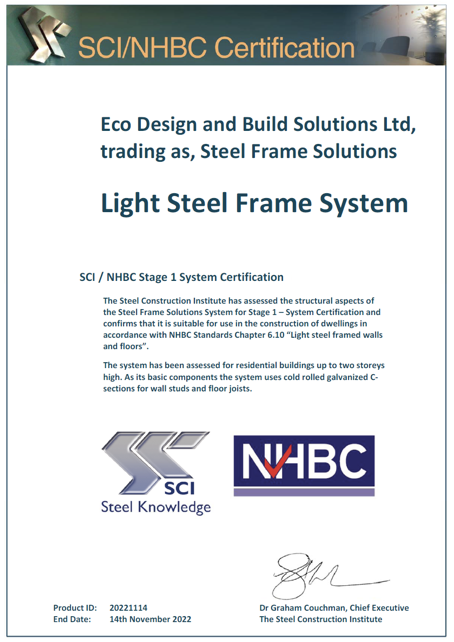
Eco Design and Build Ltd, trading as Steel Frame Solutions, have had their light steel frame system reviewed by SCI to obtain SCI/NHBC Stage 1 System Certification. The process has assessed the structural aspects of the system and confirmed that it is suitable for use in the construction of dwellings in accordance with NHBC Standards Chapter 6.10 "Light steel framing".
The system has been assessed for residential single occupancy dwellings up to two storeys high. The system uses cold rolled galvanised C-sections for wall studs and floor joists designed in accordance with BS EN 1993-1-3.
|

|
|
NHBC Stage 1 Certification for Hadley Steel Framing
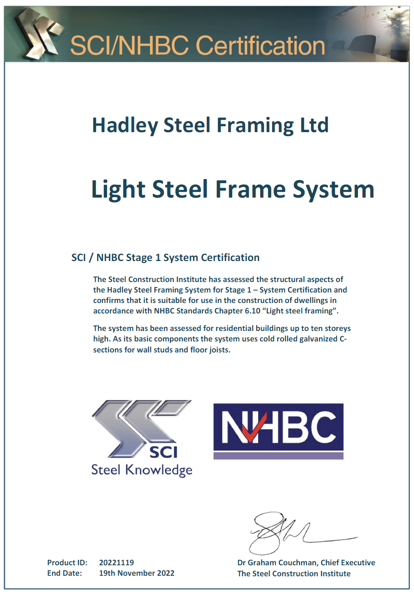
Hadley Steel Framing have had their NHBC Stage 1 Certificate renewed for another 3 years. The system has been assessed for residential single occupancy dwellings up to 10 storeys high. The system uses cold rolled galvanised C-sections for wall studs and floor joists designed in accordance with BS EN 1993-1-3.
Information on SCI assessment and certification is provided on the website along with a search facility for all the companies with SCI certification or assessment.
Please contact Andrew Way for more information on SCI/NHBC Stage 1 System Certification for light steel framing.
|

|
|
Members in the News |
|
J&D Pierce's Training Manager Tom Wallace has been shortlisted as a finalist in the 'Service Leaver of The Year' category in this years' Ex-Forces in Business Awards!
The British Ex-forces in Business Awards is a standout ceremony that commemorates veterans entering the business world and comes to Scotland on 3 December.
There are many social stigmas facing military veterans when they leave service, including unfair assumptions such as they're ill-prepared for 'real-life' and for 'real work' in the private sector. This is one of the few awards ceremonies out there that's doing its bit to dispell these misinformed views. Instead, they're highlighting the skill-sets of ex-military employees, including their applicability to high-level roles in the business world.
The finalists were chosen from a total of 250 nominations by a judging panel of military veterans.

The winner will be announced on the 3rd December at the Gala Final Awards Dinner at the Doubletree Hilton in Glasgow.
|
 |
|
Caunton's apprentices restore a colliery wheel - providing a benefit for the local community
Caunton's apprentices have refurbished an old colliery wheel which, erected by Caunton's erection department, acts as a focal point for activities at a local beauty spot called Colliers Wood.
The background to this goes back a long way. When Caunton Engineering outgrew its Kirkby-in-Ashfield works by the end of the 1980's the company relocated and invested into the Maintenance Workshops of the National Coal Board in Moorgreen in 1990. The Moorgreen Colliery itself had been demolished in 1986 - a colliery that at one time produced one million tonnes of coal per annum. Currently Caunton fabricate and install circa thirty thousand tonnes of structural steelwork from these premises. Over a number of years the shareholders have invested to regenerate the whole former colliery area. Today a new thriving trading estate surrounds the ever-expanding Caunton facilities and the surrounding area has been reconstituted into attractive farmland and countryside. One particular area within this is Colliers Wood. The Friends of Colliers Wood are creating a new activity area within the woodland scene. Part of this area will feature - most appropriately - a colliery wheel which had been rescued from the local Calverton colliery.
The colliery wheel however needed substantial repair and refurbishment, and this was a task attacked enthusiastically and skilfully by Caunton apprentices employed in the company training academy, once used to maintain and repair colliery plant and equipment. The photograph shows work being carried out by two of Caunton's apprentices.

Read More
|
 |
| SCI Advisory Questions and Answers
|
|
For SCI Sole Trader and Corporate members, SCI offers support through our Advisory Desk Service. For questions asked which we feel are pertinent to the wider member audience we publish anonymously the questions and answers.
This month our published question is about;
Weldability of structural steels of different grade.
Question: Is it permissible to weld a steel column of grade S355 to a base plate of grade S275?
Please see the answer to all Advisory questions on the SCI Information Portal.
SCI Corporate and Sole Trader Members can access the Advisory Desk by email
advisory@steel-sci.com or by phone
+44 (0)1344 636 525
|
 |
| SCI Courses, Webinars and Events
|
|
Next SCI Member webinar
Realising the Steel Design, 10 December 2019.
This webinar will look at Design, Fabrication and Erection but in reverse and from an erectors point of view to provide an overview and understanding of what the erectors require to safely build structures whilst maintaining stability.
Our guest speaker is Angus Cormie of J&D Pierce
Register to view this webinar.
|
 |
|
SCI Steel Building Design to EC3 Course, 30 January 2020, Birmingham
This one-day course will equip an engineer with:
- An overview of the Eurocode suite design document, and the critical importance of the National Annex
- A good understanding of the important ULS and SLS load combinations
- A good understanding of the key parts of
BS EN 1993-1-1
- A set of numerical examples covering frame stability, axial resistance, LTB and combined axial load and bending
- A good understanding of connection design to
BS EN 1993-1-8
For more information and to book a place on this course click here
|

|
| News in Brief
|
|
New SCI Assessment website
SCI have launched it's new Assessment website. To check whether a product has SCI Assessed or SCI/NHBC, you can search by assessment type, product or company and view a copy of the product certification to see the validation dates.
If you are looking for validation of your product, find out which is the most appropriate scheme for your product by calling SCI on
+44 (0) 1344 636501
|
 |
|
SCI visits Singapore
Nancy Baddoo is visiting both the Singapore Institute of Architects and the Singapore Structural Steel Society to make two presentations, the first on Stainless Steel in Buildings & Infrastructure for Aesthetics and the second on Durability & resilience.
|


|
|
European Conference on Plant & Process Safety
Bassam Burgan will be giving a keynote presentation entitle "Background to the development of hydrocarbon explosion and fire guidance" at the EUROPEAN CONFERENCE ON PLANT & PROCESS SAFETY in Cologne on 11 and 12 December.
|

|
| |
|
Publications |

The Design of Cast-In Plates (P416)
This guide discusses the technical issues involved in connecting the steel and concrete elements together. A model and a procedure for the design of cast-in plates is proposed including the allocation of design responsibility. The guide includes example calculations.
SCI Members: £22.50 + P&P
Non Members: £45.00 + P&P
|

Brittle Fracture Selection of Steel Sub-Grade To BS EN 1993-1-10 (P419)
This guide explains how an approach based on fracture mechanics, which is a method permitted in BS EN 1993-1-10, may be used to determine the required steel sub-grade. Application of the procedures in this guide should be limited to quasi-static structures, where fatigue is not a design consideration.
SCI Members: £22.50 + P&P
Non Members: £45.00 + P&P
|
Design of Low to Medium Rise Buildings against External Explosions (P415)
This design guide provides recommendations and advice for structural design against explosions associated with industrial accidents where the blast impacts the whole (or large areas) of the building's elevation.
PDF format only.
SCI Members £30.00
(ex VAT)
Non-Members £60.00
(ex VAT)
|
|
|
|
|
SCI on Social Media
For course reminders, publication updates and article notifications follow SCI on Twitter, Instagram and LinkedIn.
|
|
|
|
|
|
Refer a friend or colleague who you think may be interested in receiving the SCI Connect Newsletter
|
|
|
CLICK TO REGISTER
|
|
|
|
|
© 2019. This newsletter has been published by The Steel Construction Institute |
Terms
Privacy Policy
|
|
The Steel Construction Institute, Silwood Park, Ascot. SL5 7QN.
Registered in England and Wales. Registered No: 1916698.
Click here to unsubscribe
|
|
|
