Email not displaying correctly? View it in your
browser
|
 |
|
At SCI we are lucky in that given the nature of what we do we have been able to implement relatively painless measures that allow our staff to work from home effectively and ensure the necessary protection for the one or two of us who occasionally need to come in to the office.
Technology enables good communication as well as access to many of our service and product offerings online, and we are taking full advantage of its capabilities to support our members and clients with advice, consultancy, and products that are highly relevant today.
Access to technical advice continues to be either reactive (through the Advisory Desk addressing your specific questions) or proactive (publications and other resources on Steelbiz). In particular we are extending our webinar offerings.
Graham Couchman, CEO, SCI
|
The Eurocodes were coming, and they are again. But is there a better way?
Ten years ago we were getting excited because March 2010 was the date fixed for withdrawal of the previous British Standards and their 'replacement' with the Eurocodes. There was an expectation that this would mark the point when the still extensive use of the old national standards would diminish significantly. To help designers cope with the new codes - which had actually already been around for some time - preparation for that date included the production of an extensive range of SCI design guides.
In reality it hasn't of course worked out quite like that. Whilst larger design offices design to the Eurocodes, the old British Standards are still widely used (particularly by smaller design offices and for smaller projects). They are also extensively used for design and build projects, as they tend to lead to more economical designs (and/or design processes). Eight years of chairing the Eurocode 4 committee has reinforced my view that in the UK we are in a different place on a spectrum with economy at one end and conservatism at the other, compared to some of our European neighbours. It is one of the reasons why our market share for steel is so much higher. The UK's regulatory system, which is not prescriptive, and the fact that 'physics' hasn't changed, allow designers to choose. As an aside, BREXIT will make no, or at most very little, difference to the situation.
Ten years after that significant date we are now heading towards the era of the second generation of Eurocodes (not counting the ENV pre-standards). A new version of EN1993-1-1 has been prepared and is being voted on, within the CEN system, shortly. It will still be a number of years before it impacts on practice as the process is long, including the writing of National Annexes, but change is on its way. And it is considerable change.
One thing we are investigating is the fact that the Eurocodes are intended to not restrict the expert designer from using 'first principles' approaches. How this would work for insurers and clients gets us in to the whole murky world of designed 'using the Eurocodes' and 'according to the Eurocodes', but as we globally try to make better use of resources it seems inappropriate not to use knowledge we have to facilitate more efficient design.
|
|
|
|
|
 |
Floor Vibrations
21 Apr 20 - Member Webinar
|
|
|
Brittle Fracture
19 May 20 - Member Webinar
|
|
|
Curved Steel
16 June 20 - Member Webinar
|
|
|
View all courses
|
|
|
| SCI Courses, Webinars and Events
|
|
Next SCI Member Webinar is;
Floor Vibrations
Tuesday 21 Apr
This Webinar will cover:
- Theory of Vibration
- Simple Methods
- Finite Element Analysis
- Special cases - Light Gauge and Hospitals
- Mitigation Strategies
Register to view this course.
|
 |
|
Brittle Fracture - Webinar
Tuesday 19 May - 12:30-13:30
The selection of an appropriate steel sub-grade is an essential part of a designer's responsibility. The UK National Annex makes significant modifications to the Eurocode approach, which is appropriate for structures subject to fatigue. The webinar will cover the process of specifying sub-grade, both in accordance with the UK NA, and using SCI publication P419, which is appropriate when fatigue is not a design consideration.
Register to view this webinar.
|
 |
|
SCI public courses
Our booking facility via the SCI Information Portal for our publicly run courses is still open for registration, however, in the current situation we have made it possible to register for the course but we will not take payment at this time. If you are interested in attending any of our courses please register as normal.
We are looking to make some of our courses available to deliver on-line, so keep an eye on the courses on the SCI Information Portal.
We may have to postpone courses and we will contact you if the course you have registered for is running on the date advertised or provide you with a new date in the future.
For a list of our public courses visit the SCI Information Portal.
|
 |
| SigDeck Makes the Grade
|
|
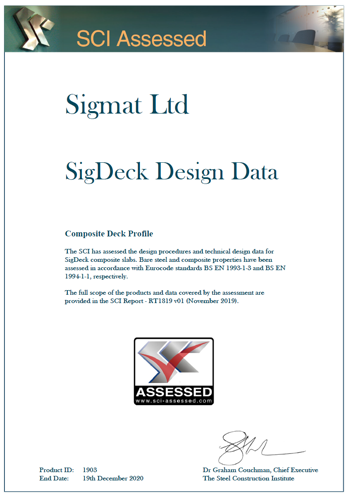
A recent addition to Sigmat's product range is their new floor deck profile - SigDeck. The S450, crushed-end, trapezoidal deck is 110mm deep and available in gauges from 0.8 mm to 1.5 mm. SigDeck was primarily developed for use with light steel framing and is therefore ideal for single span applications of approximately 5 m without the need for propping, which is beneficial for speed of construction.
The SigDeck product has been subject to an extensive range of testing and analysis to determine various performance parameters. The development work and design values have been successfully assessed by SCI, as a result, the technical performance data for SigDeck has been awarded SCI Assessed status.
The assessment included the analysis of the bare steel and composite properties of SigDeck, development of construction stage and composite stage design procedures and development of fire stage resistances. All testing and analysis have been carried out in accordance with Eurocodes where applicable.
Bare steel bending tests and end support tests were carried out to determine SigDeck sagging resistance, sagging inertia and end crushing resistance.
Composite slab tests were undertaken to determine the shear bond characteristic of SigDeck using the tau method for partial interaction. The tau method is applicable to the longitudinal shear design of the composite slab in accordance with BS EN 1994-1-1.
Due to the unique shape of the SigDeck profile, it was not appropriate to use NCCI PN005c-GB - "Fire Resistance Design of Composite Slabs" to determine the temperature profiles through the slab or the minimum insulation depths for fire design. Therefore, SCI conducted several finite element analyses of the slab to obtain temperature profiles through a SigDeck floor slab. Small scale fire tests were carried out to calibrate the results obtained from the finite element analyses.
A second aspect of the fire design which was assessed, was the performance of the slab support detail at elevated temperatures. Finite element analyses were carried out to determine the temperature profiles of the structural components and these were used to calculate the design resistances at each fire resistance period.
SCI is currently in the process of producing composite slab design software for Sigmat and their new SigDeck profile.
For more information on SCI certification and assessment services please visit our website.
|

|
| Members new Advisory Desk Service email alerts.
|
|
As a reminder to members the new Advisory Desk service emails are still being sent out fortnightly and will consist either; a reminder, an update or a new Advisory Desk Note. Our current series concerns Fire Boundary.
If you are not receiving these emails and would like to go to the SCI Information Portal and in your Profile click on notifications/alerts and select the notifications you require.
All the Advisory Desk Notes and Questions and Answers together with other technical resources are all available at all times on the SCI Information Portal.
|
 |
| SCI complete design app for Tata Tubes
|
|
The new app, available for both Android and Apple, is a powerful tool which offers users a list of hot finished hollow sections which meet their input design criteria - in an instant. In compression, users input the section type (CHS, SHS, RHS or EHS), the buckling length about both axes and the design axial load. The app returns the lightest weight in each serial size which satisfies the requirements, along with a utilization factor and information about availability. Heavier sections in the same serial size will obviously also be satisfactory, though less efficient.
In bending, users input the characteristic permanent and variable actions, and span. Design loads are calculated using expression 6.10 of BS EN 1990, assuming a UDL. The app again returns the lightest weight in each section, based on the moment resistance and a deflection check, with utilization factors for both criteria.
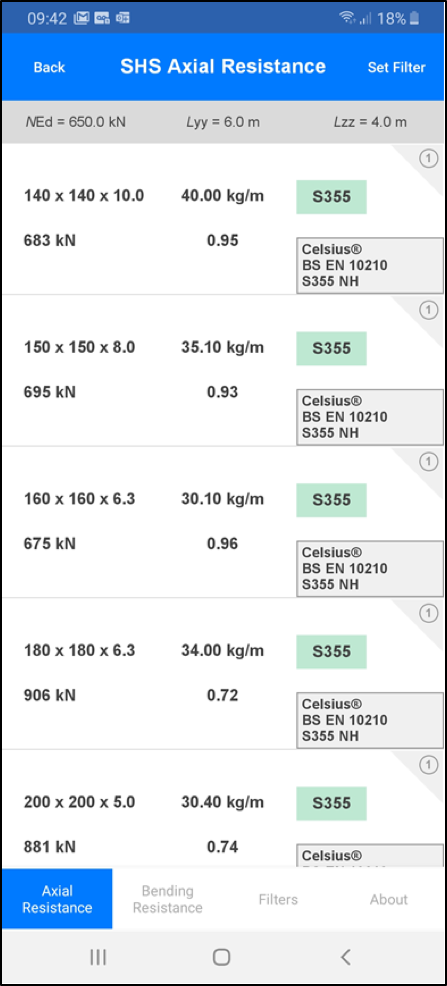
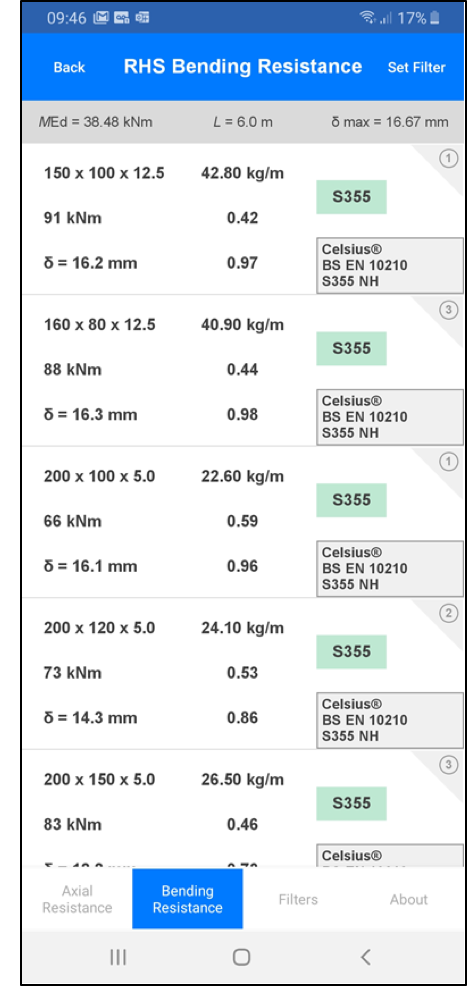
There are a number of 'neat' features in the app. Filters can be set, for the minimum and maximum size which the app should consider. Results for S355 or S420 steel can be considered individually, or at the same time. A utilization ratio limit may be input by the user, and the deflection ratio under variable actions may also be set by the user.
Having viewed the results in the app, users can simply select any of the sections and share it wherever they wish (including themselves), by all the usual methods available in mobile devices. The shared data includes all the input parameters and the output, providing a record of the calculation.
The app can be obtained from the app stores, or via www.tatasteelconstruction.com/celsiusapp
or, using the following links.


|
 |
| Fire Performance of Recessed Downlighters
|
|
Recent guidance from the NHBC may be of interest to those working in the residential market, particularly those in the light steel framing sector. The NHBC guidance highlights the need for recessed light fittings (downlighters) used in intermediate floors of houses to be supported by test evidence to achieve the required fire performance. The latest NHBC guidance on the matter is provided in the February 2020 issue of NHBC Clicks & Mortar.
There is no specific fire test for a recessed downlighter and so they must be tested as part of an overall floor construction. The whole floor is subject to the test including any elements that are to be part of that floor construction which include any recessed light fittings.
For more details please refer to NHBC guidance.
|
 |
NEW PUBLICATION
Guidance on Demountable Composite Construction Systems for UK Practice
|
|
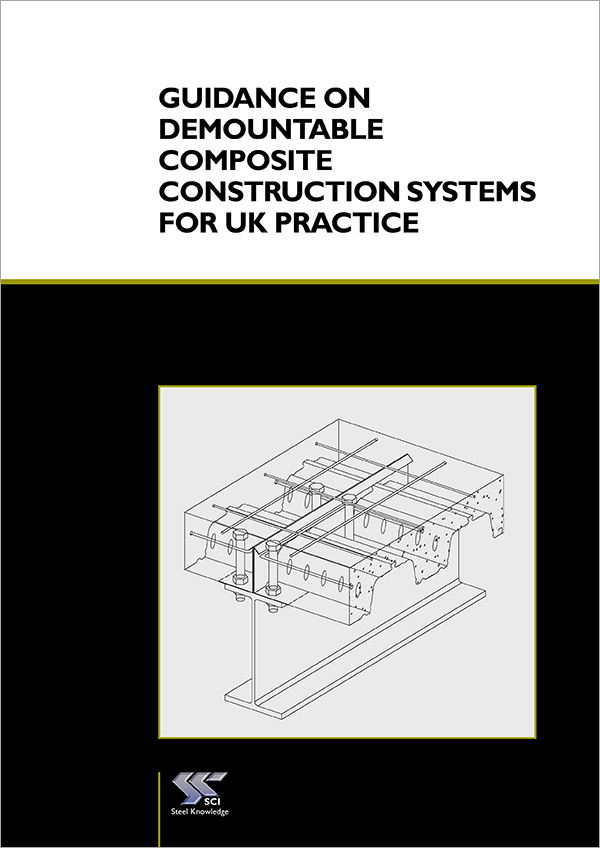
SCI has published new guidance (SCI P428) on how to design composite beams with demountable shear connectors so that the benefits of composite construction are retained and the structural elements can be deconstructed and reused. Such circular thinking will be a requirement for structural designers going forward.
This new publication is an output of the European project REDUCE in which a large number of composite beam and shear connection tests were performed at the Universities of Bradford and Luxembourg and at the Technical University of Delft to provide performance data and to correlate the test results with the proposed design methods. In the context of SCI P428, the shear connectors are in the form of bolts with nuts above and below the beam top flange that are used in combination with composite decking and partial or full depth edge trims along the centre-line of the beams to facilitate cutting, demounting and potentially re-using the slab segments as well as the steel beams.
In the UK, a cellular beam test was performed at the University of Bradford to demonstrate that the bolted shear connectors could be used to provide composite action at the large web openings as well as for the whole beam. The failure load of the 11m span composite cellular beam was over 24 kN/m2, or twice normal factored loading, and the measured end slip of the bolted shear connectors was over 8mm, which demonstrated that their plastic resistance could be achieved. In a parallel EPSRC project, the University constructed and tested two similar composite beams, the first of which was demounted after initial testing , re-assembled and re-tested, and it had exactly the same failure load and stiffness as the second beam. This gave confidence that re-use of composite beams is not only feasible but also does not lead to any loss of performance.
The design approach for composite beams with demountable shear connectors is presented in two ways: either a modified plastic analysis or an elastic analysis taking account of the flexibility of the shear connectors. The optimum distribution of shear connectors is also considered for elastic design. Two fully worked examples are presented in P428: a 12m span composite beam and a 15m span cellular beam. Recommendations for re-use of the beams and slabs are also given.
For further information or questions concerning the re-use of steel and composite construction, and the circular economy in the steel sector, contact Dr Michael Sansom.
To download your free copy go to the SCI Bookshop
|
 |
|
Members in the News |
|
Fusion achieves International Safety Award
Salvesen Insulated Frames Ltd, trading as offsite light steel superstructure manufacturer Fusion Building Systems, has been awarded an International Safety Award from the British Safety Council for protecting its employees from risk of injury and ill health at work.
Fusion won the Award based on its application which demonstrated how the Company has progressed with its standards of health, safety and welfare management. It was one of over 500 businesses recognised for their commitment to workplace healthy and safe during the 2019 - 20 calendar year.

Now in their 62nd year, the International Safety Awards recognise and celebrate organisations from around the world which have demonstrated, to the satisfaction of the scheme's independent judges, their commitment to preventing workplace injuries and work-related ill health. The Awards also recognise organisations which have shown commitment to wellbeing and mental health at work.
Read More
|
 |
|
Caunton framing two new buildings for Peterborough Gateway
Caunton Engineering are pleased to have been awarded the contract for two large distribution warehouses by major contractor Winvic Construction. They are to be located on the Gateway development in Peterborough. Gateway Peterborough is a 240 acre warehousing and distribution park being developed by Roxhill Developments Ltd. The site is strategically located, immediately adjacent to Junction 17 of the A1(M). The site has planning consent for a massive 5 million sq. ft. Industrial and distribution buildings, including buildings up to 1.3m sq. ft.
Caunton's two buildings are for Plot 210 and Pot 410, and will require nearly two thousand tonnes of structural steelwork. This will be designed by the Caunton Technical team.
Roxhill specialises in building warehouse and distribution space, with an aim to achieve BREEAM Excellent. Caunton are most pleased to be contributing to such an important development.

|
 |
| SCI Advisory Questions and Answers
|
|
For SCI Sole Trader and Corporate members, SCI offers support through our Advisory Desk Service. For questions asked which we feel are pertinent to the wider member audience we publish anonymously the questions and answers.
Where some questions relate to SCI Publications we publish the question and answers in Connect.
This month our published question is about; Tightening non preloaded grade 8.8 bolts
Question: Is there any guidance on tightening Grade 8.8 bolts that are not preloaded?
Please see the answers to this and all Advisory questions on the SCI Information Portal.
The Advisory Desk Service is for SCI Corporate and Sole Trader Members
advisory@steel-sci.com
|
|
| Colin Taylor
|
|
8 Sept 1935 - 5 Feb 2020
At SCI we were all saddened to hear Colin Taylor, a long standing employee and friend of the SCI from June 1993 - September 2000, had passed away on 5th February 2020.
Colin was one of the first people to work for the SCI, indeed joining on the day it moved to Ascot. Drawing on his varied earlier career in the field of steel construction, he was an excellent fit for the role of Senior Manager responsible for the technical Advisory Service and the Standards Department. He had already been involved in the development of BS5950 - the first UK limit state design code for steel construction - during his time at W.S. Atkins, as a result of which he was invited to become involved in the development of Eurocode 3 (a pan-European code for steel design). Initially he acted as co-coordinating engineer for the UK comments, and then became technical secretary at a European level responsible for editing and compiling drafts. This experience made him invaluable to SCI, and its members, seeking clarification and interpretation of the new code. Those of us who worked with Colin tend to remember two things - he was always the last one to leave the building, and if you asked him a question you were more likely to leave with five more questions (things you hadn't thought of) rather than an immediate answer!
|

|
| |
|
SCI Publications
Our SCI Bookshop is still open. However due to the circumstances we are able to provide you with a PDF version of publications at this time and will send out hard copies once we are back in our office.
If you are a member please log into the SCI Information Portal where you are able to view and download any publication in the Steelbiz section.
|
|
SCI on Social Media
For course reminders, publication updates and article notifications follow SCI on Twitter, Instagram and LinkedIn.
|
|
|
|
|
|
Refer a friend or colleague who you think may be interested in receiving the SCI Connect Newsletter
|
|
|
CLICK TO REGISTER
|
|
|
|
|
© 2019. This newsletter has been published by The Steel Construction Institute |
Terms
Privacy Policy
|
|
The Steel Construction Institute, Silwood Park, Ascot. SL5 7QN.
Registered in England and Wales. Registered No: 1916698.
Click here to unsubscribe
|
|
|