|
Clearly subject to any changes in the national situation, like many other organisations we will move to a 'mixed' flexible working arrangement in September, with an increased presence of staff in the office. Although working from home has proven to be effective in terms of pure delivery of work, it will be good to get a buzz around the office again with increased interaction. As well as launching a number of new initiatives, during the final half of the financial year we will be present at Offsite Expo, chairing sessions and presenting papers at EuroSteel 2020 (virtually), and running our own Annual Event (virtually). As usual for this time of year, we will also restart our courses and member webinar programme.
Having been forced to test running our courses virtually over the past 18 months, we have decided to continue in this way, at least for now, given the benefits that anyone anywhere can attend courses without needing to travel to a venue and be out of the office for a day. Our courses are structured to be run in two hour sessions over a set number of days, so that concentration levels remain high whilst learning. This approach also means attendees have time to digest material and come back with questions at the next session.
We also remain committed to running our monthly technical webinars for Members. These are run as one hour events, with a focused agenda. We endeavour to run the live webinars at a time that is convenient to the majority of viewers, however, for those less able to view the live lunchtime (BST) events, or for those that want to re-watch the webinar, a recording is available for a number of weeks after the live event.
We are also finding that there is a renewed interest in In-house training, either with us in physical attendance or by providing virtual training on specific subjects relevant to business requirements. Hopefully all this means there is renewed confidence for such things going forward into the Autumn and Winter.
For information on our courses, events and webinars view our calendar of events here. Or contact education@steel-sci.com
|
|
|
|
|
 |
Steel Building Design to EC3. Online course
4 Sessions: 9, 10, 15 & 16 September
10:00-12:00
|
|
|
Fire resistant design of steel structures - Member Webinar
14 September
12:30-13:30
|
|
|
Design for Construction - Member Webinar
12 October
12:30-13:30
|
|
|
Portal Frame Design - Online Course
4 Sessions: 20, 21, 27 & 28 October
10:00-12:00
|
|
|
View all courses
|
|
|
| SCI Assessed for new Leviat thermal windposts
|
|
Leviat, formerly known as Ancon, has recently been granted SCI Assessed status for the design of their new stainless steel thermal windposts. The windposts are used in cavity walls to connect the outer leaf of brickwork to the internal blockwork wall, and also provide lateral resistance and stiffness to withstand reversible wind loads. The Leviat windpost cross-section resembles a lipped angle section, with a continuous array of perforations along the web which is intended to reduce the thermal transmittance through the post. The windpost also has discrete perforations along the web and flange which are used for attaching tie devices (see Figure 1). The free edge of the windpost web is hemmed in order to provide increased resistance to the web against out-of-plane distortional deformations.
The complex geometry of the windpost cross-section and the type of connection details to the blockwork, meant that design of the windpost was not possible by simply using the Eurocode provisions. Instead, a limited number of tests in combination with numerical simulations run by the SCI permitted the development of tailored design equations to accurately predict the resistance and deflection of the windpost. A reliability analysis carried out by SCI ensured that all the equations developed for the design of the windpost meet the safety requirements stipulated in the Eurocode.
Based on this design methodology, Leviat has been able to produce competitive load and deflection tables for their new product which was launched in May 2021.
|
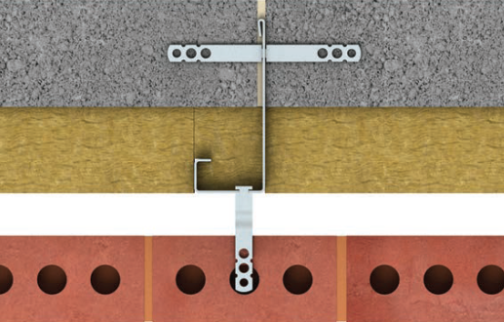
Figure 1: Leviat thermal windpost in cavity wall
|
| SCI and University of Sheffield to work in partnership to develop blast loading tools
|
|
Explosions are a persistent and significant threat to people and infrastructure worldwide. Recent examples, such as the 2020 Beirut explosion, highlight the need for engineers to understand explosions and their effects in order to provide better protective solutions. As part of this, we must be able to accurately and rapidly predict key blast loading parameters for a wide range of potential scenarios.
Currently in the UK, software used for calculating the blast loading caused by energetic materials is either general-purpose computational fluid dynamics codes or dated software that has originated from the US military. The former is expensive, complex and computationally very demanding whereas the latter is dated, often restricted, and generally not compatible with modern operating systems.
The Steel Construction Institute and the University of Sheffield have won a two-year Knowledge Transfer Partnership (KTP). This is a national scheme which helps businesses to innovate and grow, by linking them with a university with particular expertise. Under the scheme, Innovate UK will provide 67% funding to cover the costs of the university and the partnership will also benefit from industrial funding. The objective of this collaboration is to generate data and new predictive approaches using computational software tools (e.g. CFD/FEM) coupled with cutting-edge data-driven machine learning techniques to develop new algorithms for prediction of blast load parameters. These will be directly implemented in bespoke software to calculate blast loading on structures caused by energetic materials.
|

|
| Members Advisory Desk Service email alerts.
|
|
The new Advisory Desk service emails sent this month included;
Advisory Desk Note - AD 404
Artificially reducing the effective width of slab to satisfy shear connection requirements
Advisory Desk Note - AD 470
Moments due to eccentricity at a column splice
If you are an SCI Sole Trader or Corporate Member and not receiving these email alerts go to the SCI Information Portal and in your Profile click on notifications/alerts and select the notifications you require.
All the Advisory Desk Notes and Questions and Answers together with other technical resources are all available at all times on the SCI Information Portal.
|
 |
| SCI Advisory Questions and Answers
|
|
For SCI Sole Trader and Corporate members, SCI offers support through our Advisory Desk Service. For questions asked which we feel are pertinent to the wider member audience we publish anonymously the questions and answers.
Where some questions relate to SCI Publications we publish the question and answers in Connect.
This month our published question is about;
Simply supported beam end rotations
Question: The Green Book for simple connections P358 includes standard fin plate details. For beams of nominal depth greater than 610 mm, the span to depth ratio is limited to 20, as one control on the anticipated rotation at the end of the beam. What slopes might be expected at the ends of 610 serial size beams spanning 15 m, as the ratio exceeds 20?
Please see the answer to this Advisory Question/Answer - Ref No AD_QA_7161-21 and all Advisory questions on the SCI Information Portal.
The Advisory Desk Service is for SCI Corporate and Sole Trader Members
advisory@steel-sci.com | +44 (0) 1344 636525
|
|
| SCI Courses, Webinars and Events
|
|
SCI Online Training Courses
Our public courses and webinars keep engineers updated with the latest developments within steel design and equip them to design competently, efficiently and safely.
Our next course in September is:
|
|
|
Steel Building Design to EC3 - Online Course
Delivered in 4 sessions:
Part 1: 09 September 21
Part 2: 10 September 21
Part 3: 15 September 21
Part 4: 16 September 21
Each session will run from 10:00-12:00 (BST)
As the experts in steel design, the SCI have prepared this course as an overview of the Eurocode provisions for steel building design. The course focuses on orthodox construction, covering the primary design issues for practicing engineers. The course follows the process of determining actions, considering combinations of actions, frame analysis and the assessment of second order effects. The course will then demonstrate how the resistance of members are calculated, but also how they can be extracted immediately from resources such as the 'Blue Book'.
This course will equip any engineer with:
- An overview of the Eurocode suite of design documents, and the critical importance of the National Annexes
- How the appropriate steel sub-grade is determined
- A good understanding of the important ULS and SLS load combinations from EN 1990
- A good understanding of the key parts of BS EN 1993-1-1
- A set of numerical examples covering frame stability, axial resistance, LTB and combined axial load and bending
- A good understanding of connection design to
BS EN 1993-1-8
Member Rate - £250.00
SCI Non-Member - £330.00
Register for this event here.
|
 |
|
SCI Annual Event - Free Online Event
09 November 21
Time: 10:30-14:00
Our key focus will be on 'net zero' solutions and we will report on the various decarbonisation initiatives that the sector, in particular the steel producers, have embarked upon.
Presentations will be made by: Severfield Plc, ArcelorMittal, Trimble and The Institution of Structural Engineers.
In recent months we have also identified a number of areas where we believe we can help the UK steel construction sector meet its needs through the provision of new services and products. These include Trimble TEDDs modules aimed at designers, the first three of which will be launched by the end of 2021.
Less well developed is a service for assessing the thermal performance of details for light steel framing - we will present case studies of assessing performance in fire (as reported previously in Connect), and outline our plans to provide thermal modelling consultancy to assess condensation risk etc.
To attend this free event register here.
|
 |
|
Next SCI Member webinar is;
Fire resistant design of steel structures
Webinar - 14 September 21
Time: 12:30-13:30
Often, designers simply design for resistance at normal temperatures and expect the structure to be fire protected. But a little engineering can be used to calculate more realistic behaviour and to demonstrate the adequacy of the structure under fire conditions. Complex calculations can be avoided by the use of freely available design tools.
Register here to view this webinar
For a list of webinars and on-line public courses visit the
SCI Information Portal
Or contact education@steel-sci.com to discuss your requirements.
|
 |
|
|
|
|
|
Members in the news |
|
Steel Bricks system paves the way forward for UK nuclear power station construction
Caunton Engineering has constructed a blast box for warhead testing at The University of Illinois using the Steel Bricks™ modular system, which it developed in the UK with the Steel Construction Institute under license from Modular Walling Systems.
This contract lays the foundations for further projects in the UK as the system is a viable alternative to reinforced concrete for cores, tunnels and the nuclear sector. Caunton Engineering Exec Chairman Simon Bingham states "This steel and concrete walling system could radically alter the way nuclear power stations are built in the UK as it offers a less labour-intensive solution, coupled with significant cost and time reductions associated with offsite manufacture."
Steel Bricks are a ground-breaking product developed in 2014 and backed by the UK Government with nearly £1.2M in funding from Innovate UK.
Installed at the University of Illinois' campus at Urbana-Champaign, the revolutionary ultra-strong three-metre cubed chamber is now being used for explosives testing as part of a research programme on advanced warhead technologies for the US Department of Defence.
Using the Steel Bricks modular system, which comprises two steel face plates that are connected internally to create a sandwich panel, the blast box was manufactured offsite by Caunton Engineering. Once delivered and installed in its final position, it was then filled with 72 tonnes of self-consolidating concrete in one continuous pour.
|

Steel Bricks system paves the way forward for UK nuclear power station construction
|
|
SCI Publications
Our bookshop is once again open. For any hard copies of SCI Publications visit the SCI WebShop.
|
Minimum degree of shear connection rules for UK construction to Eurocode 4 (P405)
This publication looks at a number of variables that affect the minimum degree of shear connection including the type and orientation of decking, whether or not the steel beam is unpropped during construction, the presence of regular large web openings, and the utilisation in bending of the composite beam. In many cases, consideration of this broader range of variables results in less onerous requirements for the minimum degree, thereby enabling composite solutions that according to the code would be inadmissible.
|
Steel building design: Medium rise braced frames (P365)
This publication supports one of the very common uses of steel in the UK. For new designers, the guide provides an introduction to the major features of multi-storey design. For more experienced designers, the guide illustrates the key changes when designing to the Eurocode, in particular the revised approach to frame stability. A worked example showing the design of the major elements is included.
|

Design of Steel Beams in Torsion (P385)
Resistance to torsion, usually in conjunction with bending, is a design situation where designers welcome guidance. This publication explains the basic behaviour of beams in torsion and provides formulae and graphs for evaluating the effects of torsion.
|
|
|
|
|
|
|
|
SCI on Social Media
For course reminders, publication updates and article notifications follow SCI on Twitter, Instagram and LinkedIn.
|
|
|
|
|
|
Refer a friend or colleague who you think may be interested in receiving the SCI Connect Newsletter
|
|
|
CLICK TO REGISTER
|
|
|
|
|
© 2021. This newsletter has been published by The Steel Construction Institute |
Terms
Privacy Policy
|
|
The Steel Construction Institute, Silwood Park, Ascot. SL5 7QN.
Registered in England and Wales. Registered No: 1916698.
Click here to unsubscribe
|
|
