Email not displaying correctly? View it in your browser

SCI CONNECT – February 2022

Has the time finally come for semi-continuous frames? BCSA's UK structural steelwork: 2050 decarbonisation roadmap, produced with input from SCI and launched at the end of 2021, identified 'design efficiency' as one of the key ways for steel construction to achieve its targets. Design's estimated potential to contribute 18% of the 'change' needed is clearly very significant, and much of that potential is available to be exploited right now. SCI's guide to Semi-continuous Braced Frames (P183) was published in 1997, and remains entirely valid. It was written at a time when SCI was focused primarily on 'structural engineering', and had only one or two experts working on 'sustainability'. Today these previously separate disciplines have effectively merged as far as much of the guidance and advice SCI offers is concerned, with a major focus of the steelwork industry in the UK now being 'sustainable structural engineering'.

Reducing the weight of steel by 18% may sound a lot, but some years ago Prof Julian Allwood and his team from the LINK concluded that UK steel construction designers were using (in multi-storey buildings) twice as much steel as was necessary in order to satisfy design codes, standards and regulations. Much of this overdesign is down to non-technical issues, including low design fees, and the order of the design and procurement process (which means information such as some load values is lacking when needed).

A combination of low design fees, and the traditional UK approach to split responsibility for the design of the beams and columns, and the design of the joints, combine to make so-called simple design very attractive. However, an obvious outcome of simple design is that taking zero moments in the joints means that sagging moments in the simply-supported beams are maximised for a given level of loading. Semi-continuity offers many of the benefits of 'full' continuity, in terms of reducing beam sagging moments, deflections and therefore sizes, whilst retaining most/all of the benefits of simple construction in terms of fabrication cost and erection ease. This is because many joints that are assumed to act as nominal pins, perhaps with some 'thickening' of components, do in fact offer reasonable stiffness and strength. Stiffeners and haunches are not needed to achieve reasonable levels of semi-rigidity and partial strength, to use terminology from EN1993-1-8.

P183 describes how to apply semi-continuous design to braced frames. It is based on the premise that standard joints will be used, although 25 years after it was published we should be able to offer greater design/detailing freedom. In 2022 SCI and BCSA will be working together to produce guidance on sustainable design. This will include revisiting the semi-continuous frame design principles and rules. Designers today can use tools to determine joint strength, stiffness and rotation capacity, although levels of accuracy (of the last two) may be open to some question. SCI will be developing an easy-to-use tool, using Trimble's TEDDs platform, in 2022. This will allow key characteristics of 'typical' types of joint to be determined using the well accepted EN1993-1-8 component method. As TEDDs is part of the Trimble family this may also allow integration with their frame analysis and design software, which will really make semi-continuous design simple.

Contents
Feature Article
Joe Locke MBE
SCI Membership
Members Advisory Desk
SCI Advisory Q&A
SCI Webinars, Courses
& Events
Members in the News
Publications
 
SCI Courses
Steel Connection Design Online Steel Connection Design Course
2, 3, 9, 10 Mar
10:00-12:00
Steel Connection Design Acoustics Webinar
15 Mar
12:30-13:30
Steel Connection Design Fire Resistance of Light Steel Framing Webinar
5 Apr
12:30-13:30
View all courses
Joe Locke MBE

Many in the steelwork world will be saddened to hear of the passing of Joe Locke in late January. Joe will be particularly remembered for his involvement in world-renowned steel structures, including the Chek Lap Kok Airport, Hong Kong, the TGV Interchange at Charles de Gaulle Airport and the cable structure of the Millennium Dome. Joe had senior roles with several Steelwork Contractors, notably Watson Steel and William Hare. Joe was well known for his work across all aspects of steelwork, from the development of design codes to the promotion of steelwork in general. He received numerous well-deserved recognitions for his contributions to the industry, was a fantastic character, and will be sorely missed.

William Hare Logo
SCI Membership

SCI offers support to the steel industry in a number of ways, in particular by offering a number of Membership packages to suit both individuals and companies. SCI membership provides direct access to experts, supported by technical resources and best practice guidance, to save you time and money.

Our membership support varies depending on what you need at the time. Direct access to our advisory team, consistently ranked by members as the most valuable benefit, offers fast, independent, authoritative advice. Each enquiry is dealt with confidentially. The Advisory team's extensive knowledge covers all aspects of steel design and construction, including interpretation of code requirements.

If you wish to find out more about SCI Membership visit our membership page or contact the Membership team membership@steel-sci.com

SCI Member Logo
Members Advisory Desk Service email alerts.

The new Advisory Desk service emails sent this month included;

Advisory Desk Note - AD 408
Effective Length of Cantilevers(Revised)

Advisory Desk Note - AD 482
Responsibilities for Reinforcement Design and Detailing in Composite Slabs and Beams

If you are an SCI Sole Trader or Corporate Member and not receiving these email alerts go to the SCI Information Portal and in your Profile click on notifications/alerts and select the notifications you require.

All the Advisory Desk Notes and Questions and Answers together with other technical resources are all available at all times on the SCI Information Portal.

SCI Member Logo
SCI Advisory Questions and Answers

For SCI Sole Trader and Corporate members, SCI offers support through our Advisory Desk Service. For questions asked which we feel are pertinent to the wider member audience we publish anonymously the questions and answers.

Where some questions relate to SCI Publications we publish the question and answers in Connect.

This month our published question is about;
Correlation factor βw

Question: When verifying the resistance of a fillet weld between S275 and S355, should an average value of βw from Table 4.1 of BS EN 1993-1-8 be taken?

Answer: The value of βw (and the ultimate strength, ƒu) should always relate to the weaker material, so
βw = 0.85 and ƒu = 410 N/mm2 for S275 steel.

This is Advisory Question/Answer Ref No: 7167-22

For all other membership Advisory Question /Answers please visit the the SCI Information Portal.

The Advisory Desk Service is for SCI Corporate and Sole Trader Members advisory@steel-sci.com | +44 (0) 1344 636525

SCI Member Logo
SCI Courses, Webinars and Events

SCI Online Training Courses

Our public courses and webinars keep engineers updated with the latest developments within steel design and equip them to design competently, efficiently and safely.

Online Steel Connection Design Course
Part 1 - 02 March 22
Part 2 - 03 March 22
Part 3 - 09 March 22
Part 3 - 10 March 22

This course is for designers and technicians wanting practical tuition in steel connection design. The course concentrates on the design of nominally pinned connections, in accordance with BS EN 1993-1-8, considering vertical shear and tying.

The Eurocode approach to the design of moment resisting connections will be discussed, anticipating that software will be used for the design of these connections. Bracing connections, bases, splices, welded joints and non-standard connections will all be covered. The Eurocode rules for ordinary and pre-loaded assemblies will be discussed. Critical design checks and rules of thumb will be identified, for preliminary connection sizing.

The objectives of this course are:

  • to equip designers with the knowledge to design common connections with confidence
  • to explain the key principles of connection behaviour which must be realised in connection details
  • to generate an awareness of the resistance of standardised connections
  • to explain the complexities of the design of moment-resisting bolted joints

Having attended this course, you will:

  • be able to design nominally pinned connections to the Eurocode
  • appreciate the design process for bolted moment-resisting connections
  • understand the principles to be applied to unorthodox connection configurations

Member Rate: £250.00 +VAT
Non Member Rate: £330.00 +VAT

To attend thise register here


SCI Logo

Next SCI Member webinar is;

Acoustics Webinar -
15 March 22
Time: 12:30-13:30

This webinar will provide an introduction to the sound and acoustic performance of steel framed buildings. It will include background information on sound and implications for acoustic detailing, regulations and requirements

Register for this event here

SCI Logo
Members in the news

Green light for major redevelopment plans

British manufacturer John Reid & Sons (Strucsteel) Limited, which trades in the UK and globally, has won planning permission for major redevelopment of its site in Dorset.

The company - known as REIDsteel - has received the green light from BCP Council for a state-of-the-art manufacturing complex, new offices and staff facilities in Christchurch.

The redevelopment of the REIDsteel site and adjacent land formerly occupied by Peeks Party Store will deliver a 6.4-acre manufacturing base and boost the company's capability.

Managing director Simon Boyd said: "This is absolutely brilliant news for REIDsteel, the local economy and GB plc.

"It is a milestone in the long history of the company, which has gained a worldwide reputation for high quality British engineering, design and manufacturing. "It will allow us to significantly increase productivity, create more highly-skilled employment and apprenticeships, and boost the local economy while cutting our carbon footprint.

"In addition, the new facility will enhance our ability within both the domestic and export markets. "Our thanks go to BCP Council and their planning team for their support throughout the process.

"They have worked with our planning consultants and architects to achieve a well-balanced development which will contribute significantly to the local community. "All those involved with the planning process had the vision required to understand the importance of delivering a state-of-the-art manufacturing facility on a key site in Christchurch for the long-term growth of our company.

"Furthermore, they recognised the positive effect it will have on our local community which I also thank for their support."

REIDsteel's portfolio includes aircraft hangars, bridges, sports stadia, and industrial and commercial buildings across the UK, Europe and the world, including cladding and glazing, alongside its Special Projects - which include hurricane and earthquake resistant structures, car parks, defence structures, water treatment plants, the power sector, infrastructure, specialist bridges and bespoke designs.

Founded in 1919, the company has exported to more than 140 countries to date.

Simon added: "Our people are our company, where every one of our 130 employees is a valued team member; together we are One Team.

"This is a very welcome decision and is essential to our drive for continuous improvement, and not just for manufacturing but for our people who are at the core of everything we do. It is a landmark moment as we look forward to an exciting future."

REIDsteel has gained full planning permission for the multi-million-pound-redevelopment, which will include a production yard, staff parking accessed from Mill Road, environmental improvements and landscaping. It will also include rooftop solar panels and electric vehicle charging points.

Multiple manufacturing processes will be brought into a single, automated production line with cutting-edge technology from concept to delivery under one roof. REIDsteel is now working through the next steps of the scheme. It will continue with current operations on the site throughout the redevelopment process.

The company is a Platinum Business Partner with Dorset Chamber of Commerce and Industry.

It continues to be active with Bournemouth University on the development of new technology and maintains links with local schools for work experience.

It has signed the UN's Race to Zero pledge and is working towards the gold standard of the BCSA's Sustainability Charter.

REIDsteel was the first contractor to sign the UK Steel Charter with UK Steel in support for British manufacturing.

It is a member of the British Constructional Steelwork Association (BCSA) and the Confederation of British Industry (CBI).

John Reid & Sons (Strucsteel) Limited is known as REIDsteel
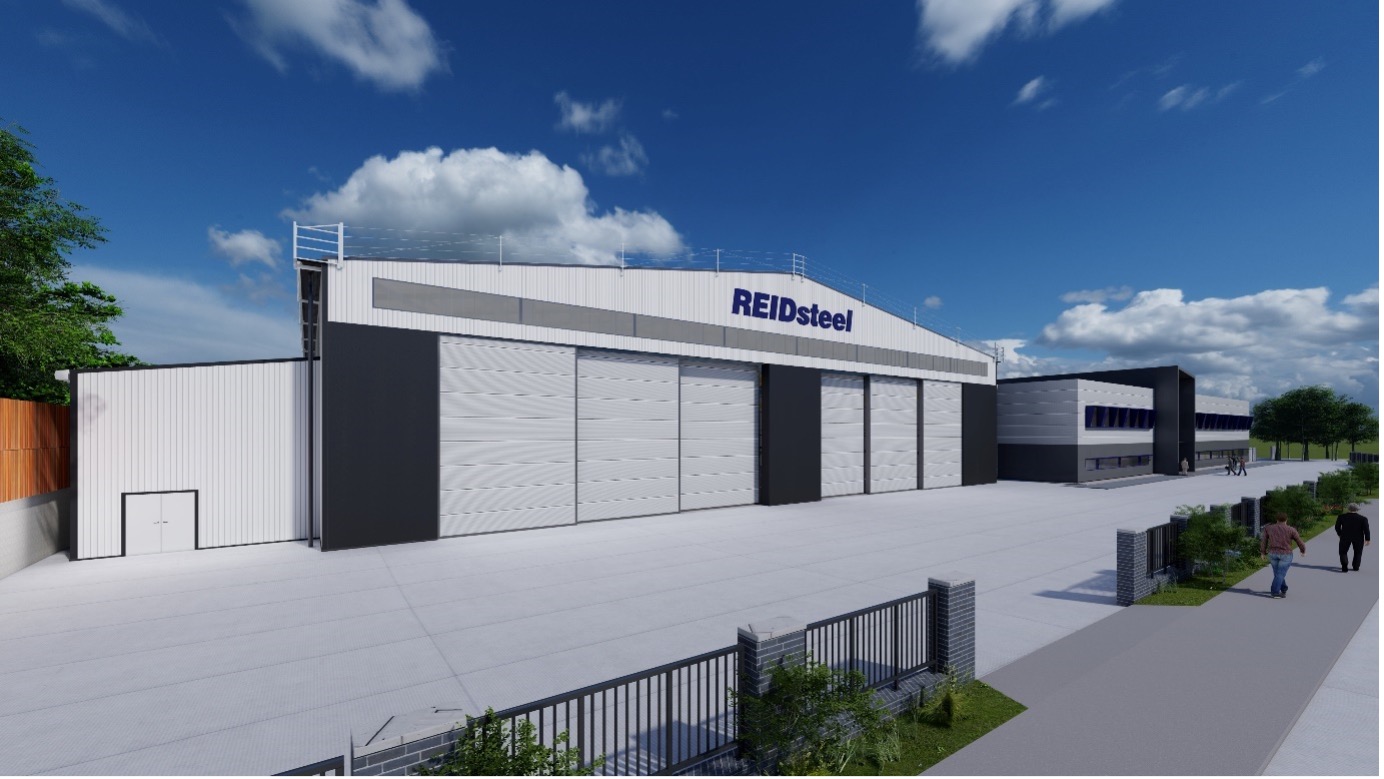


GREEN LIGHT: Artist's impression of new manufacturing base and offices at REIDsteel in Christchurch, which has been given planning permission by BCP Council
REIDSteel Logo

SCI Publications

Our bookshop is once again open. For any hard copies of SCI Publications visit the SCI WebShop.

Design of Semi-Continuous Braced Frames (P183)

Design of Semi-Continuous Braced Frames (P183)
In a semi-continuous frame the degree of continuity between the beams and columns lies between that assumed traditionally in simple or continuous design. The degree of continuity can be chosen to produce the most economic balance between the primary benefits associated with these two traditional alternatives.

Acoustic detailing for steel construction (P372)

Acoustic detailing for steel construction (P372)
This publication gives acoustic details for steel framed buildings with a range of floor and wall constructions. The guidance is based on acoustic test results and information published by manufacturers and suppliers of plasterboard, light steel framing, acoustic systems and associated products. It provides advice to architects, designers and other construction professionals on detailing to achieve the required acoustic performance.

Steel building design: Design data

Steel building design: Design data "Eurocode Blue Book" (P363)
The "Blue Book" is the essential aid for the design of steelwork. Comprehensive tables of member resistances are given for S275 and S355 steel, to enable rapid selection of steel members in compression, bending and tension. Tables are also provided for combined bending and compression, web resistance and shear resistance.

SCI Shop
SCI SHOP
SCI SHOP
SCI on Social Media

For course reminders, publication updates and article notifications follow SCI on Twitter, Instagram and LinkedIn.

Twitter LinkedIn
Connect Sign Up
Refer a friend or colleague who you think may be interested in receiving the SCI Connect Newsletter
CLICK TO REGISTER

© 2022. This newsletter has been published by The Steel Construction Institute | Terms Privacy Policy

The Steel Construction Institute, Silwood Park, Ascot. SL5 7QN.
Registered in England and Wales. Registered No: 1916698.
Click here to unsubscribe