|
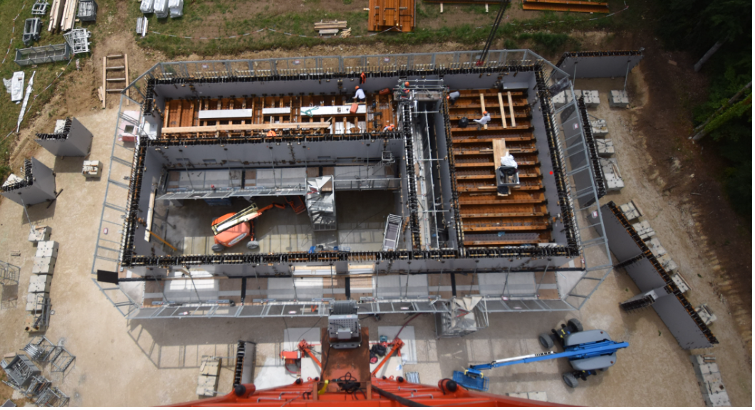
Construction of a full-scale replica of a reinforced concrete diesel generator building used as a post Fukushima safety measure on all EDF nuclear reactor facilities in France has started on site. The building houses diesel generators, fuel tanks, electrical rooms, air intake rooms and ventilation rooms. The generators provide electrical power in the event that all other means of electrical power supply have failed.
The demonstration replica building is being constructed in modular composite construction (MC2) to quantify the time and cost benefits of MC2 over reinforced concrete. The building is rectangular on plan (24.1 m x 12 m) and 14.94 m high. It is part of a project led by SCI, with partners EDF, CEA, EGIS, Bouygues, Peikko and ArcelorMittal and with funding from the European Commission's Research Fund for Coal and Steel and industrial sponsors ENRESA (Spain), Framatome, ORANO and ADF (France). The demonstration building is being constructed at Les Renardierès, Moret-Sur-Loing in France.
The building walls comprise two steel plates connected by a grid of tie bars; shear studs are also welded to each plate. The void between the plates is filled with concrete. This eliminates the need for reinforcing bars as the plates act as both permanent formwork and reinforcement to the concrete. Floors comprise a single steel bottom plate reinforced by T-stiffeners; shear studs are welded to both the plate and the flange of the T-stiffeners and concrete is cast over the plate and stiffeners. Several methods of connecting modules together on site are being explored, including bolting, automated welding and the use of dowel bars.
The modules were fabricated at Peikko's factory in Lithuania in sizes up to 9.0m x 3.9m. Wall modules are either planar, L-shaped (corner modules), T-shaped (with a starter part for an internal wall or double TT-shaped (for starter parts for two internal walls). The modules were manufactured to tolerances defined in the project and validated using detailed measurements and selective laser scanning. Devices attached to the module plates in the fabrication shop allow easy levelling of modules and alignment of module plates. The modules have also been equiped to support the working platforms on site without the need for additional support. Modules are now being transported by road and erected at the construction site in France.
Throughout the design, manufacture and construction process, extensive use has been made of building information modelling (BIM) to coordinate the project activities, eliminate clashes and for easy traeability of all components.
Construction on site started in May and the building is expected to be competed by September, a five month construction schedule. Data available from 58 diesel generator buildings of similar size and complexity shows that the building structure takes 10 months to complete in reinforced concrete.
Contact Bassam Burgan for further information.
|
|
|
|
|
 |
Steel Frames & Disproportionate Collapse Rules
11, 13 & 15 July
10:00-12:00
|
|
|
Cold Formed Portal Frames - Member Webinar
12 July
12:30-13:30
|
|
|
Essential Steelwork Design Course
06, 07, 13 & 14 September
10:00-12:00
|
|
|
SCI Tedds Modules: Turning SCI Guidance into Designer Tools
13 September
12:30-13:30
|
|
|
View all courses
|
|
|
| How are considerations of embodied carbon affecting your business?
|
|
We held our first Round Table discussion on 23rd June to consider this topic, with a broad range of contributors chosen to give coverage to all key stakeholders. External circumstances made it impractical for us to meet as planned in London, but nevertheless it was great to meet on-line with our invited guests:
- Alex Baalham (Whitby Wood)
- Rory Bergin (HTA)
- Jonathan Davis (William Hare)
- Roy Fishwick (Cleveland Steel and Tube)
- Penny Gowler (Elliot Wood)
- Stephen Hall (Hadley)
- Suria Jones (LendLease)
- Walter Swan (Arcelor Mittal)
In particular we were keen to hear about the level and types of information that specifiers need, and what manufacturers are currently offering. There has been huge progress made in a very short period of time concerning how clients, designers and others think when specifying materials, although it is clear that there remains a need for consistent and product specific information. More education is also needed to avoid well-intentioned but only partly-informed specifiers following the wrong route.
We also discussed if and how considerations of embodied carbon are affecting choice of structural forms and elements. They clearly are, but again it was felt more guidance on what options are available would help. Later this year we will be publishing guidance, funded by BCSA, that will show designers what options they should consider.
We also considered how demountable solutions are being adopted, and how we might overcome the logistical problems associated with using 'pre-owned' steel elements. It is clear that re-use holds much promise, despite some practical issues. We should be more flexible when thinking about re-use - elements do not need to be used in the same type of application as first time around.
The input of all those who participated is most gratefully acknowledged. The event was both informative and enjoyable.
|

|
| ABM Week, 7 - 9 June 2022, São Paulo, Brazil.
|
|
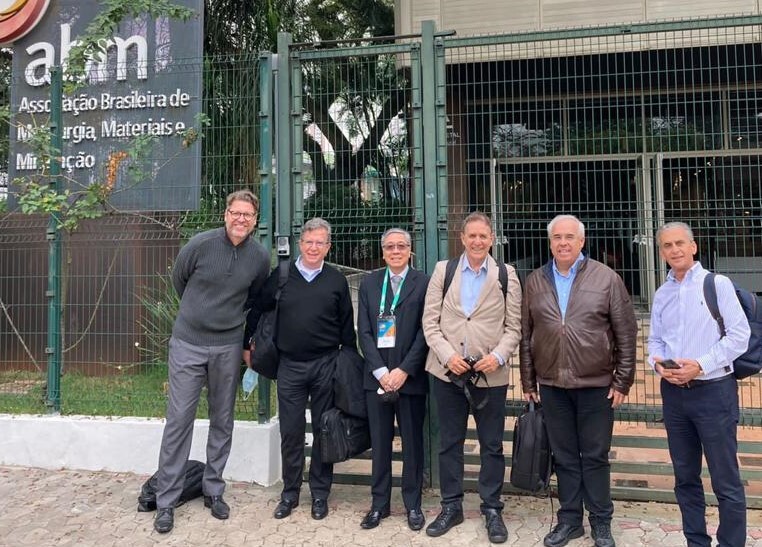
SCI Director, Bassam Burgan, participated in the first Panel on Metallic Construction, held on 8 June during the 6th ABM WEEK, to discuss the challenges, demands and solutions for a greater use of steel in infrastructure and buildings in Brazil.
Discussions focused on greater productivity, faster construction and better quality control, in addition to flexibility and easy adaptation of buildings. Sustainability benefits of steel construction, with almost zero waste, low impact on site, as well as lower generation of greenhouse gases in the use of high-strength steel, were highlighted.
The panel discussion, which was divided into three parts addressed the demands of the Brazilian market and the available competitive solutions. In the first part of the meeting, mediated by the president of Brafer Construções Metálicas and vice-president of the Brazilian Association of Metallic Construction (ABCEM), Marino Garofani, Professor Ricardo Fakury, from the Federal University of Minas Gerais (UFMG), and Eduardo Zanotti, Executive Director of the Brazilian Center for Steel Construction (CBCA), discussed the current state of steel construction in Brazil. The total tax burden on steel structures can be as much as 148% higher compared to concrete structures. Market share is also impacted by cultural issues, lack of technical information, inaccurate views about cost and lack of skilled labour and good professional training in steel design. Steel construction is also under-studied and under-researched in educational institutions.
In the second part of the meeting, dedicated to competitive solutions on the international stage, Alejandro Wagner (Director, Alacero) started by comparing data on steel consumption in Brazil and Latin America as a whole with other parts of the world, highlighting the scope for growth in steel construction.
Bassam Burgan (SCI Director), Carlos Rebelo (University of Coimbra) and Luis Pupin (Global R&D Brazil at ArcelorMittal) presented different innovations that have been developed to leverage the benefits of steel construction and maintain its market lead. A common theme was the environmental and economic benefits of the more extensive use of steel, underpinned by better design, more efficient use of higher performance materials and standardization for greater propensity of reuse of structures at end of first life.
The final part of the meeting focused on solutions for the domestic market. Tomás Vieira de Lima (Director of Steel Structure at the Brazilian Association of Structural Engineering and Consulting ABECE) highlighted the prejudices that steel and composite construction still face in Brazil, such as misconceptions about cost durability and fire resistance. Alexandre Jordáo (Market Development Specialist at Companhia Brasileira de Metalurgia e Mineração, CBMM) focused on the use of microalloyed steels with niobium and how they help in greater dematerialization of buildings.
|
|
| Members Advisory Desk Service email alerts.
|
|
The new Advisory Desk service emails sent this month included;
Advisory Desk Note - AD 379
Tying resistance of full depth end plates
Advisory Desk Note - AD 488
Thickness of Galvanising
If you are an SCI Sole Trader or Corporate Member and not receiving these email alerts go to the SCI Information Portal and in your Profile click on notifications/alerts and select the notifications you require.
All the Advisory Desk Notes and Questions and Answers together with other technical resources are all available at all times on the SCI Information Portal.
|
 |
| SCI Advisory Questions and Answers
|
|
For SCI Sole Trader and Corporate members, SCI offers support through our Advisory Desk Service. For questions asked which we feel are pertinent to the wider member audience we publish anonymously the questions and answers.
Where some questions relate to SCI Publications we publish the question and answers in Connect.
This month our published question is about;
Shear centre of a channel
Question: How do I determine the shear centre of a channel?
Answer: The distance from the web centre line to the shear centre is given by:
e0 = (b-tw/2)2 (h-tf)2tf/4Iyy using Blue Book notation
(see Timoshenko S, Strength of Materials Part 1).
The formula is for a cross section without fillets. A check
will show the formula reproduces the values for PFCs in
the Blue Book.
This is Advisory Question/Answer Ref No: 7171-22
For all other membership Advisory Question /Answers please visit the the SCI Information Portal.
The Advisory Desk Service is for SCI Corporate and Sole Trader Members
advisory@steel-sci.com | +44 (0) 1344 636525
|
|
| SCI Courses, Webinars and Events
|
|
SCI Online Training Courses
Our public courses and webinars keep engineers updated with the latest developments within steel design and equip them to design competently, efficiently and safely.
|
|
|
Steel Frames & Disproportionate Collapse Rules
This course will be delivered in 3 Sessions:
Part 1 - 11th July
Part 2 - 13th July
Part 3 - 15th July
Timing: 10:00-12:00
This course provides a solid introduction into the design of steel framed buildings to avoid disproportionate collapse. The guidance provided is in accordance with the current Building Regulations, the Eurocodes and Approved Document A which all required that disproportionate collapse must be considered in the design of all buildings.
Member Rate: £250.00 +VAT
Non Member Rate: £330.00 +VAT
To attend this course register here
|
 |
|
Next SCI Member webinar is;
Cold Formed Portal Frames
12 July 22
Time: 12:30-13:30
This popular form of construction includes all the usual features of portal frame design with the additional impact of flexible connections and Class 4 sections. The webinar will cover how these frames should be correctly designed.
Register for this event here
|
 |
|
Members in the news |
|
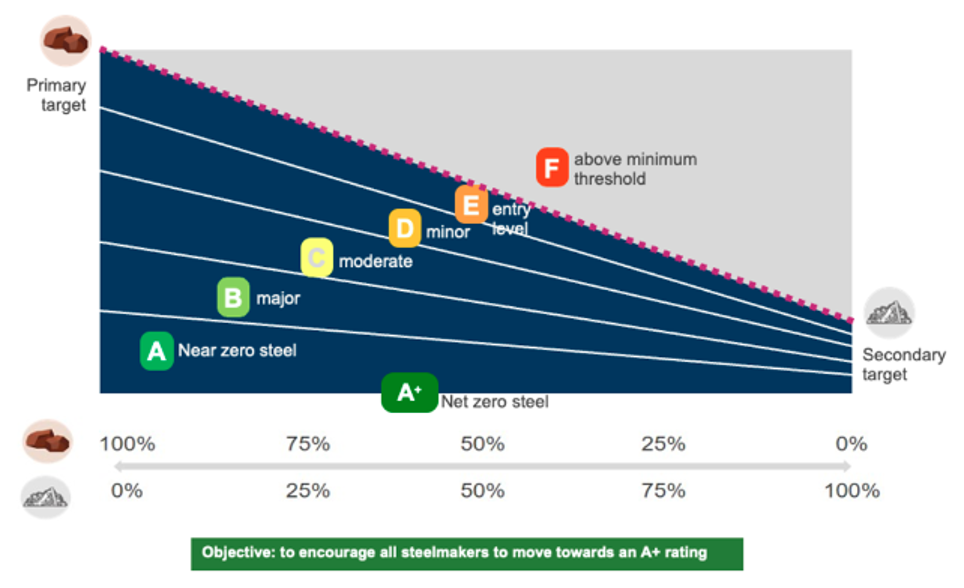
Creating a level playing field for steel specification and procurement
Today, steel products that have the lowest embodied carbon will come from an electric arc furnace (EAF) manufacturing route using 100% scrap feedstock.
By contrast, steel products made from primary resources in the blast furnace/basic oxygen furnace (BF-BOF) will have embodied carbon values (cradle to gate) approximately 5 times greater than EAF.
It's acknowledged, due to the significant gap between global steel demand and scarp arisings, that primary steel making will be required for some time to come, and it needs to be net-zero.
Specifiers making a simple binary choice will choose EAF sourced material every time, but is this the correct decision?
How does a designer make the choice between a market leading primary steel producer that is aligned with goals of the Paris agreement and a less engaged EAF producer?
The new global standard concept from ArcelorMittal may provide a fair and equitable way to make the right decision.
More details here
|

|
|
New Members |
|
SCI would like to welcome new members;
Compass Engineering Ltd
Alexander Associates (Salisbury) Ltd
A structural and civil engineering consultancy providing specialist advice relating to the residential, commercial, development and construction sectors. Clients range from homeowners through to blue chip construction and development companies, often designing one-off domestic homes.
|
|
|
SCI Publications
Our bookshop is once again open. For any hard copies of SCI Publications visit the SCI WebShop.
|
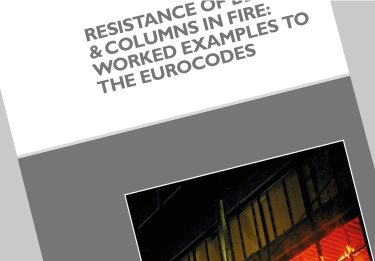
Resistance of beams & Columns in Fire (P403)
Two substantial worked examples form the main content of this publication. The first example is a two-storey structure with non-composite beams and a modest minimum fire resistance period of 30 minutes. The second example is a seven-storey structure with composite beams and a more onerous minimum fire resistance period of 90 minutes.
|
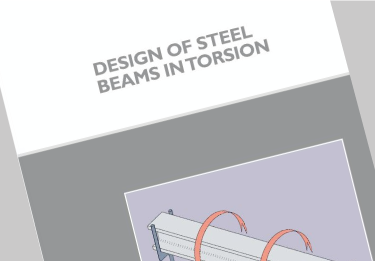
Design of Steel beams in torsion (P385)
This publication explains the basic behaviour of beams in torsion and provides formulae and graphs for evaluating the effects of torsion. Practical guidance is given on the design in accordance with Eurocode 3, including the interaction of torsion with bending resistance and buckling resistance.
|
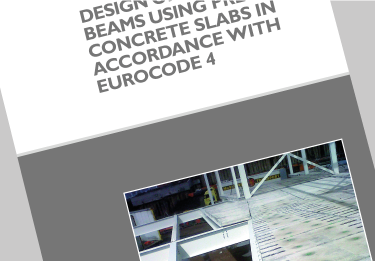
Design of Composite Beams Using Precast Concrete Slabs -EC4 (P401)
This publication takes previously published guidance from P287 and presents updated guidance in accordance with the principles of Eurocode 4, supplemented by non-contradictory complementary information (NCCI). The guidance discusses the particular issues affecting the use of precast concrete concerning the requirements of effective shear connection and transverse reinforcement.
|
|
|
|
|
|
|
|
SCI on Social Media
For course reminders, publication updates and article notifications follow SCI on Twitter, Instagram and LinkedIn.
|
|
|
|
|
|
Refer a friend or colleague who you think may be interested in receiving the SCI Connect Newsletter
|
|
|
CLICK TO REGISTER
|
|
|
|
|
© 2022. This newsletter has been published by The Steel Construction Institute |
Terms
Privacy Policy
|
|
The Steel Construction Institute, Silwood Park, Ascot. SL5 7QN.
Registered in England and Wales. Registered No: 1916698.
Click here to unsubscribe
|
|