| Annual Event 2022 - London 1st November
|
|
Although the on-line versions worked surprisingly well, we are excited to be able to go back to holding our Annual Event physically this year. A number of presentations will focus on the theme for the day - how getting the joints right can save money, save material, and avoid failures. He probably wasn't thinking about bolts, welds and end plates, but as Mies van der Rohe once said 'the devil is in the details'. Powerful tools enable us to do exciting things, but care is needed. Complex joints need careful thought and communication, and may be facilitated by different manufacturing techniques. Thought and communication are also prerequisites for the correct use of semi-continuous design, something we need to start taking more seriously as an easy way to reduce material usage. All these aspects will be covered by a series of presentations.
Other topical subjects for the day will include the use of 'low carbon' alternatives for floor slabs, be they concrete or CLT. And of course the second-generation Eurocodes are now taking share, with key technical content now more-or-less defined. Even though the codes will not be published for serval more years, designers may wish to start exploiting some opportunities they offer. Continuing to look to the near future, with implications for now, we will also give thought to the use of Augmented Reality as a means of quality checking steel structures.
The event will be held at 1 Birdcage Walk, Institute of Mechanical Engineers, London.
Register for this event here .
|

|
| Cavity barrier tests in light steel framing applications (SCI-P438)
|
|
A new technical information sheet from SCI presents the results of a programme of cavity barrier tests in light steel framing applications.
Cavity barriers are provided in cavities within buildings (e.g. between the cladding and the building structure) to sub-divide the cavity so that the spread of fire and smoke is inhibited in unseen voids. Cavity barriers are also provided at the edges of cavities (e.g. around door and window openings in the façade) to inhibit fire and smoke entering the cavity or the building.
Cavity barriers are generally tested in a cavity formed with concrete or masonry on each side. To demonstrate the performance of cavity barriers in light steel applications, SCI collaborated with members of its Light Steel Forum and two cavity barrier manufacturers to undertake a programme of cavity barrier testing. A full list of the collaborating companies is provided in SCI-P438.
The test programme included tests to replicate construction with masonry cladding and either masonry or light steel frame inner leaves so that a direct comparison could be made. A total of 11 tests were carried out including various light steel frame wall constructions, four types of sheathing board and two types of external insulation. Full details and results are provided in SCI-P438.
The main conclusion from the test programme is that the performance of cavity barriers between masonry cladding and an inner leaf of light steel framing is equivalent to the performance between two leaves of masonry.
SCI-P438 'Cavity barriers in light steel framed buildings' is available here.
|

|
| Get more out of Tekla Tedds, with SCI Tedds Modules
|
|
Tekla Tedds is a software tool, widely used by engineers throughout the UK and abroad, to facilitate structural design and calculation. Recognising the software's popularity, SCI has begun development of a range of specialist Tedds modules further extending Tedds' already wide range of calculation tools. In many cases, these SCI modules will supplement an SCI publication or Advisory Desk note by providing a tool that implements the design process that has been described.
SCI's expert knowledge and experience, coupled with a first-hand understanding of the issues facing the industry, through our technical support to our members, uniquely places us to develop high-quality tools which will be of use to practising engineers.
The first of these modules was released earlier this year. Titled "SCI
P424 - Method for Extending Fire Test Results", this first module implements the procedures described in one of SCI's newest publications, P424 "Fire Resistance of Light Steel Framing". Allowing loaded wall or floor fire test results to be extrapolated to a wall or floor with certain variations in its specification, the module not only makes the calculation easy, but also has credibility with checking authorities and warranty providers due to its SCI provenance.
The next module, considering the design of service openings in composite slabs, is titled "SCI P300 - Composite Slab Openings Designer" and will be released in the coming weeks. Further modules are already in development covering different aspects of composite design and light-gauge construction.
On Tuesday September 13th, SCI will be presenting a webinar to introduce the first of these specialist SCI modules. Both SCI P424 - Method for Extending Fire Test Results and SCI P300 - Composite Slab Openings Designer modules will be explained and demonstrated with an example. There will also be a preview of other modules currently in development and due to be released later this year.
SCI modules will be offered as add-ins to Tekla Tedds on an annual subscription basis, with different options to cover organisations of different sizes.
Visit the Portal Training Calendar to book a place on the webinar. Any questions on SCI's Tedds modules can be directed to teddsmodules@steel-sci.com.
|

|
| Members Advisory Desk Service email alerts.
|
|
The new Advisory Desk service emails sent this month included;
Advisory Desk Note - AD 382
Bending resistance and moment-shear interaction limits for longitudinally stiffened beams designed to EN 1993-1-5
Advisory Desk Note - AD 492
Effective Length of valley columns
If you are an SCI Sole Trader or Corporate Member and not receiving these email alerts go to the SCI Information Portal and in your Profile click on notifications/alerts and select the notifications you require.
All the Advisory Desk Notes and Questions and Answers together with other technical resources are all available at all times on the SCI Information Portal.
|
 |
| SCI Courses, Webinars and Events
|
|
SCI Online Training Courses
Our public courses and webinars keep engineers updated with the latest developments within steel design and equip them to design competently, efficiently and safely.
|
|
|
Essential Steelwork Design
This course will be delivered in 4 Sessions:
Part 1: 6 September
Part 2: 7 September
Part 3: 13 September
Part 4: 14 September
Timing: 10:00-12:00
This online course introduces the concepts and principles of steel building design, before explaining in detail the methods employed by Eurocode 3 for designing members in bending, compression and tension. Load combinations, frame stability, brittle fracture and connection design are also covered. The methods are illustrated through a series of worked examples and workshops.
The course will highlight the similarities and major differences between BS 5950 and the Eurocodes but it will not assume any prior knowledge of either code.
The exercises will focus on the Eurocode design methods.
The objectives of this course are:
- to introduce the concepts of limit state design and explain the calculation of load combinations for ULS and SLS;
- to provide information on the correct specification of steel grade and sub grade;
- to explain the principles of frame stability and robustness;
- to describe local buckling and the requirements for section classification;
- to provide details of how to design steel members, including restrained and unrestrained beams, compression members and tension members.
Having attended this course you will:
- understand the principles of steel building design;
- be able to confidently specify steel for building purposes;
- be familiar with the key clauses in EC3 for member and frame design.
Member Rate: £250.00 +VAT
Non Member Rate: £330.00 +VAT
To attend this course register here
|
 |
|
Next SCI Member webinar is;
SCI Tedds Modules: Turning SCI Guidance into Designer
13 September 22
Time: 12:30-13:30
This webinar will introduce and demonstrate the first of the newly released SCI add-in modules for the popular 'Tekla Tedds' software. The features of these modules will be illustrated and related to current SCI guidance. The webinar will conclude with a preview of future modules coming soon to the SCI Shop.
Register for this event here
|
 |
|
SCI Publications
Our bookshop is once again open. For any hard copies of SCI Publications visit the SCI WebShop.
|

Joints in steel construction. Moment-resisting joints to Eurocode 3 "The Green Book" (P398)
This publication covers the design of moment-resisting joints in accordance with Eurocode 3. Moment-resisting joints are typically found in portal frames and in continuous construction. This publication is the successor to Joints in steel construction - Moment connections (P207/95), which covers connections designed in accordance with BS 5950
|
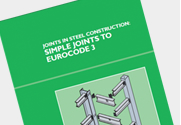
Joints in Steel Construction. Simple joints to Eurocode 3 'The Green Book '(P358)
This publication is one of a series of "Green Books" that cover a range of steelwork connections. This publication provides guidance for nominally pinned joints (the most common joint type in steel building structures) that primarily carry vertical shear and, as an accidental limit state, tying forces. The connections are designed in accordance with Eurocode 3 and its UK National Annexes.
|
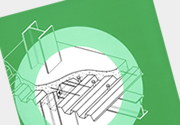
Joints in Steel Construction. Composite Connections. (P213)
This publication is one of a series of "Green Books" that cover a range of steelwork connections.
It provides a guide to composite, end plate, bolted connections suitable for use in semi-continuous braced frames. Both beam-to-beam and beam-to-column details are considered. Guidance on frame design procedures is also given.
|
|
|
|
|
|
|
|
SCI on Social Media
For course reminders, publication updates and article notifications follow SCI on Twitter, Instagram and LinkedIn.
|
|
|
|
|
|
Refer a friend or colleague who you think may be interested in receiving the SCI Connect Newsletter
|
|
|
CLICK TO REGISTER
|
|
|
|
|
© 2022. This newsletter has been published by The Steel Construction Institute |
Terms
Privacy Policy
|
|
The Steel Construction Institute, Silwood Park, Ascot. SL5 7QN.
Registered in England and Wales. Registered No: 1916698.
Click here to unsubscribe
|
|