European Commission recommend SCIENCE as showcase success story
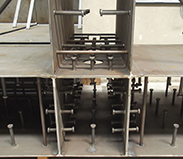
SCI together with UK and European partners have completed a four year European funded project SC for Industrial, Energy and Nuclear Construction Efficiency (SCIENCE) investigating the behaviour of SC structures.
SC is the name of a generic steel-concrete composite construction system using planar components comprising two steel plates connected by a grid of tie bars with structural concrete between the plates. The plates act as load bearing formwork during the placement of the concrete (core) and, in the completed condition, they provide the reinforcement to the concrete. The tie bars, apart from holding the two plates together during transportation, erection and concreting, act as transverse shear reinforcement. Composite action between the steel plates and the concrete core is achieved through the use of headed shear studs welded to the steel plates.
Several manufacturers of third generation nuclear reactors have made composite steel-concrete (SC) modular construction an integral part of new nuclear power plant (NPP). Modularization using SC structural elements speeds up construction, simplifies the attachment of equipment support points and reduces costs. However, whist design codes were developed in Japan, South Korea and more recently the USA, there has been no European guidance for the design of SC structures.
The final project report was presented to the European Commission’s Expert Monitoring Group (TGS8) and was recommended for showcasing as a success story. Read the full article. |
|
|
| |
An innovative form of Steel-Concrete (SC) Structures for Nuclear Power plants
New generation NPP manufacturers have been developing modular construction techniques that make greater use of pre-fabrication and factory assembly and reduce reliance on site activity. Most have adopted a technique that uses composite steel/concrete (SC) modules made by pouring concrete between two steel plates. The plates serve the dual purpose of reinforcement and permanent formwork to the concrete. Shear studs welded to the inside surfaces of the plates ensure composite action between the steel and concrete and can be spaced such that the compression steel plates do not buckle under load. They also provide the means for easy attachment of support points for equipment, eliminating the need for embedded steel plates or concrete expansion anchors.
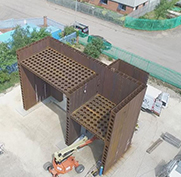
To support the surface plates during assembly, lifting, transportation, concrete pouring and curing, the two plates must be connected together to form a self-supporting unit. In this way, parts of modules may be fabricated off-site and transported as units to be assembled on-site and connected together. Many attempts have been made over the past 25 years to devise practical, economic and safe methods of connecting the plates. SCI has been working with SCI Member Caunton Engineering in a project funded by Innovate UK to design and construct a new generation of SC modular construction (‘Steel Bricks’) that overcomes the manufacturing problems of earlier SC systems. A Steel Brick is made by cutting a pattern into a flat steel plate and then folding the plate to form an ‘L’ shape. Shear studs are welded to the sides of the ‘L’ section and then two ‘L’ shaped plates are welded to form a ‘U’ shape. The circular holes in the base of the ‘U’ allow concrete to flow between bricks joined side-by-side and Steel Bricks can be welded together to create large structural modules. The base of the ‘U’, which is integral to the Steel Brick, provides the means of holding the two sides of the panel together and acts as out-of-plane shear reinforcement to the concrete.
Following completion of several workshop and field trials, a full scale structure (part of a diesel generator building on a nuclear power plant site) has been constructed to demonstrate the buildability of the system.
A full paper demonstrating the research findings is available at ICE as part of their ICE Proceedings. |
|
|
| |
OFFSITE Awards 2017 – Winners
Graham Couchman presented the winning award for ‘Best Use of Steel’.
The winner’s trophy went to SCI Members; MJH Structural Engineers & their partners Vision Modular for their winning entry. Apex House.
Highly Commended: were SCI member EOS Facades for Court No.1 Wimbledon.
For a full listing of the winners go to OFFSITE Awards 2017. |

|
| |
Events
Designing in stainless steel
Tuesday 26 September 2017, Imperial College London
This one day seminar will launch the Fourth Edition of the Design Manual for Structural Stainless Steel and will equip engineers with the skills necessary to design structural stainless steel in accordance with current European design practice, the seminar will demonstrate design versatility and highlighting procurement issues. Each delegate will receive a copy of this new publication.
The seminar is part of PUREST (Promotion of new Eurocode rules for structural stainless steel), a European dissemination project funded by the Research Fund for Coal and Steel.
Cost to attend £50, refreshments included.
To register contact: Education@steel-sci.com
For more information go to SCI Courses.
|
 |
SAVE the Date – SCI Annual Event
Steel Construction 2030 – Opportunities and needs
Tuesday 14 November, Royal College of Physicians, London
Despite much overuse of the word ‘innovative’, the construction sector has always been relatively conservative. Speakers from both SCI and our member companies will look at some of the developments that could become of growing relevance over the coming decade, including new forms of construction, solutions to minimise the use of new materials and maximise the benefits offered by steel, and the appearance of a second generation of Eurocodes. Drivers will change and push steel construction in these directions, but how long will it take?
To register your place contact: Education@steel-sci.com |
 |
| |
SCI People
A cycling theme among SCI staff
In the baking heat over the 17-18 June weekend, SCI staff were out on their bikes. Mark Allen completed the London-Brighton race to raise money for The British Heart Foundation. Graham Couchman was riding thirty-five-year-old vintage steel in the Peak District. We hope they enjoyed their days and survived them well.
|
 |
|
SCI Publications
|
 |
 |
 |
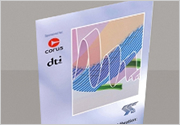
Acoustic detailing for steel construction (P372) This publication presents the general principles of sound insulation, the regulatory requirements for modern residential buildings and generic acoustic solutions using steel construction technologies. |
Design of floors for vibration. A new approach - Revised edition, February 2009 (P354) This publication presents guidance for assessing the vibration behaviour of floors in steel framed buildings caused by pedestrian traffic. |
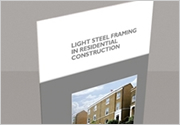
Light steel framing in residential construction (P402) The guidance addresses all the criteria that need to be considered and explains how these can be achieved with light steel framing. |
|
|
|
| |
| |
| |
SCI New Members
SCI would like to welcome new member;
Langley Structures Ltd
BluePrint (Blue & Co Ltd)
Nationwide Structures Ltd
|

|
| |
| |
SCI Members in the News
Fusion steps up recruitment drive to meet offsite demand
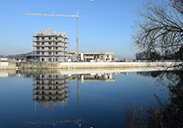
Northampton-based Fusion Building Systems has recently appointed two new team members and advertised for a further seven, in response to new contracts being won by the business as the popularity of offsite construction methods increases.
|
|
|
Lindapter’s Type HD clip specified by Hitachi
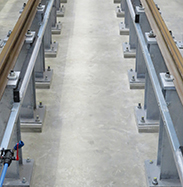
Lindapter’s M20 Type HD rail clip was used to secure low speed rails throughout Hitachi’s train manufacturing and assembly plant in Newton Aycliffe, Country Durham.
|
|
|
Free revised ‘Blue Book’ launched by Tata Steel and SCI
Tata Steel has partnered with the Steel Construction Institute (SCI) to produce a brand new revised version of their ‘Blue Book’ software tool for use in the design of structures using hollow sections. Design tables are far more accessible.
|
|
|
Anniversary milestone for steel firm – SMD
A construction company formed in the year building work started on the channel tunnel is celebrating its 30th anniversary after growing to be one of the leading players in the UK steel industry.
|
|

|
Caunton’s steelwork “flat pack” for new IKEA Exeter store is “ready to assemble”
Caunton are working yet again for the world’s largest furniture retailer IKEA. Caunton are contracted to main contractor McLaughlin and Harvey to design, supply and erect nearly 2300te of structural steelwork for their new Exeter store.
|
|

|
| |
|
|
|
| |
| |
Twitter Suggestion
For course reminders, publication updates and article notifications follow SCI on Twitter.
|
Connect Sign Up |
Refer a friend or colleague who you think may be interested in receiving the SCI Connect Newsletter |
| CLICK TO REGISTER |
|
| |
© 2017. This newsletter has been published by The Steel Construction Institute Terms | Privacy Policy |
The Steel Construction Institute, Silwood Park, Ascot. SL5 7QN. Registered in England and Wales. Registered No: 1916698.
We are limited by guarantee. |