
New publication- Minimum Degree of Shear Connection rules for the UK (P405)
For many years composite construction has played a major role in the commercial success of the steel construction sector in the UK. However, changes to profiled steel decking over the past decade (which succeeded in making the decking more efficient) have had the adverse effect of reducing shear stud resistances in some common situations. So whilst composite slabs have become more efficient, many designers will be aware that it has become impossible to achieve some composite beam solutions that had previously been possible and indeed common. Using rules from EN1994-1-1, or indeed BS5950-3.1 as amended in 2010, it is not possible to fit enough studs on the beam over some important span ranges, particularly when transverse trapezoidal decking is present.
SCI has been working in this area for almost ten years, recognising its commercial significance to the sector. Numerous beam and ‘push-out’ tests have been undertaken to determine the performance of shear studs in modern forms of construction. Recently this has led to the production of a new (electronic only) publication; Minimum Degree of Shear Connection rules for the UK (Free for members to download). The rules given in this new publication, for shear stud resistance and minimum degree of connection, complement those given in Eurocode 4. In so doing they will enable valid designs to be produced for a broader range of beams. This complementarity is possible because P405 considers a much broader range of variables than it was possible for the drafters of EN1994 to consider, including beams that are unpropped, only part utilised in bending, and with large web openings.
SCI Courses |
|
 |
Design with High Strength Steels 10 Nov 15, Webinar |
 |
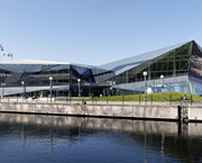
The Past, Present and Future of Steel Construction 12 Nov 15, The Crystal, London |
 |
Steel Building Design to EC3 24 Nov 15, Edinburgh |
Supply of steel to UK constructionThe very sad news from UK steel producers in the second half of October has prompted some potential specifiers to question whether steel remains a suitable choice for building, or if supply will become an issue. If we consider that during the past decade Chinese steel production has grown to a level where it more-or-less matches that from the rest of the world combined, we can immediately see that 1) it is difficult to imagine supply becoming a problem [at least for many years to come] 2) European steel producers with welfare, energy and environmental costs, and state aid restrictions, are going to struggle to compete unless they can differentiate. The news makes our Annual Event to be held on the 12th November, at the Crystal, London even more topical. Mike Walsh of Hatch Consulting will illustrate how history tells us that the future for steel is bright. He will discuss how the technologies of steel production have evolved and what the limitations for steel products are. Generation of revenue from producing steel, not by selling tonnage, but from differentiation and the provision of good service will also be considered. Carl Perry of BlueScope will take a global perspective to consider how products and construction processes change to suit different economic and technical drivers. He will highlight the trend to use less, but higher strength, steel and the other materials it must compete with. By considering different markets we can see how UK products and practice may evolve. To listen to the speakers and contribute to the discussions please register your attendance. |
|
||||
Nuclear power stationsSizewell B nuclear power station was designed in the late 1980s. The plan was for it to be the first PWR in a run of such stations. Over a period of only two or three years this run reduced to only Sizewell B, so not surprisingly it was rather expensive with no ‘production run’ to share the ‘prototype costs’. Over the past two or three years SCI has been working in this area as the UK once again gears up for nuclear power – building what was planned to be the second of the PWR’s following immediately on from Sizewell B. Is it surprising that attracting funding is not so easy for something that is such a political hot potato and has such a long return on investment? |
 |
||||
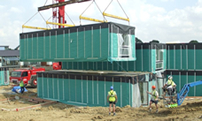
Modular Construction DevelopmentOver the last three years the SCI has been the lead partner in a European funded project for the development of modular construction systems. The project with the acronym MODCONS is now coming to an end with results and findings being disseminated through a variety of sources. MODCONS was funded by the European Commission under the Seventh Framework Programme (FP7) to support Small and Medium Sized Enterprises (SMEs). The project partners come from four different European countries and include modular manufacturers, architects, research organizations and specialist consultants. The partners are SCI, FutureForm/Renascent, HTA Design, NEAPO, Technical University of Tampere, Tecnalia, AST, IA3, CoolHaven and University of Coimbra. The project was specifically aimed at developing modular systems suitable for high-rise construction; there were five key technical areas of investigation:
SCI’s role in the project was varied and demanded expertise in several technical areas. The work undertaken by SCI included; management of structural testing and analysis of results to develop design guidance, finite element analysis of modular structures subject to different loading and support conditions, embodied carbon investigation, sustainability review, dissemination and project management. Detailed information on the different work packages undertaken during the project is available at the project website – www.modcons-research.eu. Also available on the website are case studies, video links and related project documents for download. Contact Andrew Way, Associate Director, SCI +44 (0)1344 636577 |
|
||||
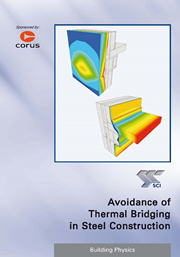
New Thermal Bridging GuidanceSCI has just begun working on two new publications providing guidance on thermal bridging. The first publication will be an update to SCI publication P380 “Avoidance of Thermal Bridging in Steel Construction” and will focus on guidance for hot-rolled steel framed buildings. This publication is being supported with funding from Schöck; specialist in thermal break solutions. The second publication will focus on guidance for buildings constructed using load-bearing light steel framing. This publication will build on knowledge that SCI has gained during recent European research projects and is being supported with funding from the Light Steel Forum. |
|
||||
UKCES - Offsite Construction Skills project completedSCI and its partners from the Light Steel Forum recently completed a project to produce best practice guidance for light steel construction. The project was co-funded by the UK Commission for Employment and Skills (UKCES). The objective of the UK Futures programme is to enhance skills in the offsite construction sector, enabling the sector to grow and help meet the ever-present demand for new housing. This growing sector currently accounts for 7% of the total construction output and is worth over £1.5 billion to the economy. SCI’s project sought to address the information needs and improve collaboration between different professionals by producing four best practice guides to help site supervisors and project managers improve efficiency on site and reduce waste through being better informed about the whole construction process. As part of the development and testing of project resources, 76 individual companies were consulted. 1050 sets of the guidance have already been disseminated to the construction industry and 482 visitors have viewed the best practice resources on the Light Steel Forum website For download of the best guidance information sheets visit the Light Steel Forum Website Contact Andrew Way, Associate Director, SCI +44 (0)1344 636577 |
 |
||||
SCI PeopleIntroducing Constantinos Kyprianou, Senior Engineer, SCI Constantinos joined the SCI in August 2013 and is currently participating in a range of research projects with focus on steel-concrete composite construction. His most recent work is relevant to the nuclear design practice and design to prevent accidental failures from actions such as blast loads and seismic effects. He is also actively involved in the software development team at the SCI with responsibilities of technical engineering development and checking of software. Constantinos graduated from Imperial College, London with a MEng and ACGI in Civil Engineering in 2013. His dissertation included experimental and computational analysis on stainless steel open sections entitled “Structural behaviour of laser welded stainless steel sections”. In the summer of 2011, he undertook voluntary work in El Salvador for two months, sponsored by Imperial College, with focus on seismic retrofitting of rural timber housing while applying sustainability concepts and aiding in educating these thoughts to the local society. |
|
||||
SCI Publications |
|||||
 |
 |
 |
|||
Design of composite beams using precast concrete slabs in accordance with Eurocode 4 (P401) This new publication takes the previously published SCI guidance provided in Design of Composite Beams using Precast Concrete Slabs (P287) 2003 based on BS 5950-3:1990 and presents updated guidance in accordance with the principles of Eurocode 4, supplemented by non-contradictory complementary information (NCCI). |
Design of composite beams with large web openings (P355) Composite floor beams are a preferred solution for |
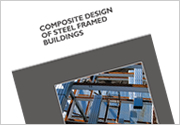
Composite design of steel framed buildings (P359) Steel-concrete composite floor construction makes efficient use of structural materials to achieve an economic solution, making it a preferred form of construction for steel framed buildings. |
|||
|
|
|
|||



SCI New Members
SCI would like to welcome the following new members:
Patterson Heggie Consulting Engineers

SCI Members in the News
Caunton Waste to Energy steelwork orders “come in threes”.
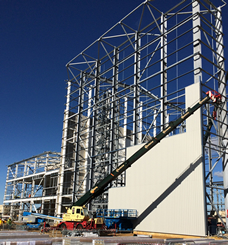
Caunton are delighted to have been entrusted with the order for the steelwork for the new straw-fired Renewable Energy Plant (REP) at Snetterton, Norfolk.This is the third order in the past two years for power plants constructed by Burmeister & Wain Scandinavian Contractor (BWSC). Caunton have already supplied the steelwork for BWSC plants at Sleaford and Brigg. The order is for over 1400te of structural steelwork for this Waste to Energy plant. The steelwork will be framing the Boiler House, the Turbine Hall, the Offices, Straw Barns, the Straw Conveyor & Wood Chip Buildings. Caunton's Secondary Steelwork Division is adding to this with supplying the Access Stairs, Ladders, Flooring and Hand railing. The project is being engineered by the Danish office of consultants Ramboll.
The facility will be operated by BWSC, who will own it in partnership with a Danish infrastructure fund managed by Copenhagen Infrastructure Partners. The facility, which will have an electrical capacity of 44.2MW, is the world’s largest water cooled vibrating grate straw-fired boiler. The facility is expected to be operational by around mid-2017. Snetterton biomass plant will bring significant benefits to the local economy in Norfolk. As well as providing a number of jobs associated directly with the plant, it will generate an annual investment of around £9 million in the agricultural economy through contracts for the supply of around 240,000 tonnes of straw per year.
Caunton are very pleased to be associated with such an exciting, ambitious and beneficial project.
SEND YOUR NEWS |

Twitter Suggestion
For course reminders, publication updates and article notifications follow SCI on Twitter.
Connect Sign Up |
Refer a friend or collegue who you think may be interested in receiving the SCI Connect Newsletter |
| CLICK TO REGISTER |