
Structural engineer who presided over the transformation of the structural steelwork industry
Victor Girardier presided over the revolution in structural engineering that occurred in the latter two decades of the 20th century. Initially as Chief Executive of one of Europe’s largest steelwork companies in the 1980’s, and thereafter as Director of the Steel Construction Industry Federation (SCIF) in the 1990’s. This revolution which changed the industry over these two decades from a craft industry to a technology-based one, was sparked by the introduction of computer aided design and manufacture. Victor played a significant role in introducing this, and then encouraging its utilization throughout the industry.
Edward Victor Girardier was born in Salford in 1935, of parents who were both blind, and had memories of rubbing shoulders there with L S Lowry. He was educated at Manchester Grammar School and left at the age of sixteen when he joined a local steelwork manufacturing company, Edward Wood, based in Trafford Park Manchester, and trained to be a structural engineer. He subsequently joined Redpath Brown also based in Trafford Park. After nationalization of the British Steel Industry in 1967, the company became part of Redpath Dorman Long (RDL), a division of British Steel Corporation. In 1975 he became Commercial Manager of RDL’s manufacturing division, then in 1978 Sales and Marketing Director of RDL International, targeting overseas contracts which included Iran, and finally in the early 1980’s was appointed Chief Executive of RDL. The company supplied the engineering and the steel framing for many prestigious contracts in the 1980’s, including Broadgate then the largest commercial development in Europe.
British Steel Corporation sold RDL to the Trafalgar House Group in the late 80’s and Victor became a director of the Trafalgar House Structural Division. In response to a request from the steelwork industry, Trafalgar House agreed to a secondment for Victor, and he was appointed the Director of the Steel Construction Industry Federation. The industry was aware of the need for the industry’s three main organisations – BCSA (representing steelwork manufacturers), British Steel (steel making) and SCI (research) - to co-ordinate their market development activities. Victor played a leading role in this, as the three bodies came together to further the success of structural steel, which now enjoyed over 70% market share in commercial building and 90% market share in industrial building.
His support included contributions to several important projects, such as the “Green Book” guides, which he promoted as industry standards. Victor will be remembered as part of the movement that encouraged standardisation and best practice in all forms.
In addition to his over-arching responsibilities across the sector, Victor contributed directly to some of SCI’s project activity. He was keenly interested in continuing to improve industry efficiency, playing an important role in joint projects examining the potential future shape of the sector. In a more personal way, Victor acted as a professional mentor for the SCI Directors, contributing to SCI’s strategy.
His work was recognised with the award of the Fellowship of BCSA and an Honorary Member of SCI.
Victor had suffered from poor health for some time, but after retirement from SCIF he acted as a non-executive director for the Bone Group in the early 2000’s, and for Caunton Engineering for over twenty years until shortly before his death.

SCI Courses |
|
 |
Essential Steelwork Design – 2 day course 8 March 2016, Birmingham |
 |
Design of Portal Elements – Part 2 22 March 16, Webinar |
 |
EC4 Composite Design 14 April 16, Bristol |
European Research FundingAs Britons reflect on our future in Europe, it is interesting to consider that The European Coal and Steel Community (ECSC) was founded after World War 2 to create a common market for coal and steel. It was a forerunner of the European community we see today. Since 1995 SCI has enjoyed research funding coming from ECSC, later in the guise of the Research Fund for Coal and Steel (RFCS). As well as enabling us to grow our knowledge in collaboration with partners from around Europe, it has contributed Euro13m of funding for a total of 38 projects to date. |
|
||||
New composite beam checking tool releasedSCI has updated the Composite beam checking tool to include the latest guidance on minimum degree of shear connection in SCI P405. The tool is one of a suite of software tools developed by SCI and freely available here. SCI has developed software products for a range of clients in the steel construction sector. If you are interested in developing user-friendly design tools to help designers specify and use your products and systems please contact Michael Sansom. | 
|
||||
New SCI websiteThe new SCI website was launched in January and over 5000 visits so far suggest it is worth a look http://www.steel-sci.com/. The News and Media area includes regular updates on both SCI and our members. The training pages are regularly updated with information on the courses we run across the UK and our lunchtime webinars for members. A list of our current members can be found on the membership pages. As well as our new website we will be improving other SCI sites over the next few months. |
|
||||
Ash & Lacy awarded “SCI Assessed” for SFS systemsAs part of the “SCI Assessed” scheme, SCI has recently completed a review of Ash & Lacy’s SFS walling systems. The assessment by SCI included an examination of section properties, resistance data and design procedures produced by Ash & Lacy for their SFS Infill and Oversail walling systems. As a result Ash & Lacy can now proudly display the SCI Assessed logo on their SFS literature and relevant website pages. All products included in the SCI Assessed scheme are provided with a certificate and are listed on the SCI Assessed website. 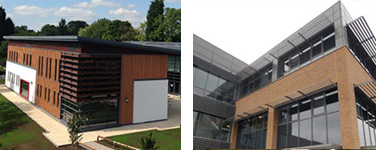
|
|
||||
CANAM – awarded “SCI Assessed” for Open web JoistSCI have completed a technical assessment of CANAM open web joists, to support their introduction into the UK. Open web joists are a common form of construction in North America, for long span floors and roofs. In North America, there is a Steel Joist Institute (SJI) specifically for this type of construction. Joists are typically fabricated from back-to-back angles as chords and small channel members as internals. CANAM joists are already CE Marked and so can be placed on the European market, but it was important to ensure that the design process was fully compliant with the Eurocodes and reflected the provisions of the UK National Annex. SCI has reviewed extensive documentation covering the entire design process from the determination of the variable actions to the individual member verification. SCI is pleased to record that the design process undertaken by CANAM is entirely appropriate. The design process conforms to the Eurocode and the UK National Annex, with additional guidance taken from SJI documents. The design of CANAM joists is therefore recognised as SCI Assessed and noted on the website http://www.sci-assessed.com/. 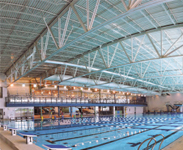
|
|
||||
SCI PeopleIntroducing, Dr Graham Couchman, CEO, SCI
Following graduation, Graham worked for Taylor Woodrow on a number of sites, followed by two years in a design office. This was followed by five years spent as a research assistant at the Swiss Federal Institute of Technology in Lausanne, where a PhD was gained concerning the behaviour of steel-concrete composite beams. This is also where he learned to speak French. Return to the UK in the mid nineties involved a short period at Mott MacDonald carrying out bridge assessments. Nine years were then spent at the Steel Construction Institute, finally achieving the grade of Senior Manager running the Light Gauge Construction Division. This period included authorship of a number of publications covering frame and connection behaviour, and good practice for composite construction. Graham joined BRE in September 2004 to run the Centre for Structural and Geotechnical Engineering and (from October 2005) the Centre for Materials and Engineering. The latter encompassed structural and materials testing, timber technology, concrete technology, wind loading, geotechnics, acoustics and airtightness. He returned to the SCI in September 2007 and took over the Directorship in November 2007. Following restructuring of SCI’s governance he became CEO in 2009. Since April 2011 Graham has Chaired CEN/TC250/SC4, the committee responsible for Eurocode 4. |
|
||||
SCI Publications |
|||||
 |
 |
 |
|||
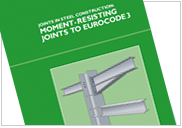
Joints in Steel Construction. Moment resisting joints to EC3 (P398) This publication covers the design of moment-resisting joints in accordance with Eurocode 3. Moment-resisting joints are typically found in portal frames and in continuous construction. |
Joints in Steel Construction. Simple joints to Eurocode 3 (P358) This publication provides guidance for nominally pinned joints (the most common joint type in steel building structures) that primarily carry vertical shear and, as an accidental limit state, tying forces. |
Joints in Steel Construction. Composite connections (P213) It provides a guide to composite, end plate, bolted connections suitable for use in semi-continuous braced frames. Both beam-to-beam and beam-to-column details are considered. Guidance on frame design procedures is also given. |
|||
|
|
|
|||




SCI New Members
SCI would like to welcome the following new members:

SCI Members in the News
Caunton working at Stoke for ProLogis
Caunton are pleased to be once again working for ProLogis, and at Stoke on this occasion,on their massive ProLogis Park development. The site is situated at the junction of the A500 and A50 outside Stoke town centre This is giving excellent north/south road links via the M6 and east/west links to the M1.
Planning was approved for 640,000sqft for a benchmark ‘One World’ sustainable industrial scheme that will utilise the latest green technologies. It is reported that the units will include two covering 500,000sqft along with smaller units totalling 105,000sqft. Caunton are supplying over 1600te of steelwork for the first of these developments for main contractor Winvic Construction. The occupier will be the major home-ware retailer, Dunelm.
The steelwork, designed by Caunton, comprises a Six Span Portal Frame Warehouse, with hit and double miss valley columns, with two hub offices, and a stand-alone two storey main office.


SCI Members in the News
EOS Facades on a roll!
One of the UK’s leading specialist metal roll-forming companies, EOS Facades, is expanding its section capability with a significant investment in new roll-forming machinery that has been specially commissioned and shipped halfway around the world to the manufacturing facility in Newton Aycliffe, County Durham.
Originating from New Zealand, this Howick machine along with four others already owned by EOS Facades currently roll sections ranging from 65mm, 100mm and 150mm deep in a range of gauges from 1mm, 1.2mm and 1.6mm thick.
Current outlets for the multi-award winning EOS Facade sections include SFS infill walling and cladding markets plus the interior fit-out market. The introduction of the new machinery will significantly complement the range of sections available and this will expand EOS’ target market with a particular focus on the opportunity to supply the volumetric modular building industry with sections now ranging from 150mm deep to 250mm deep and in gauge thicknesses ranging from 1.2mm to 2mm.
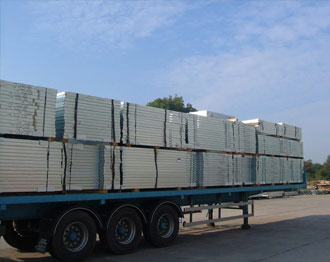
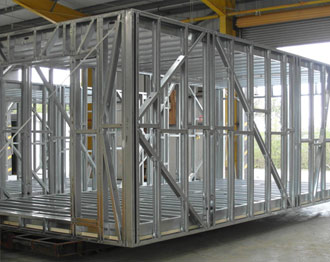
Sections provided by EOS Facades can be supplied in ‘loose’ bundles to make up in situ installation or as fully made up infill wallings produced offsite as pre-fabricated cassettes or lattice beams for both roofing and flooring applications. The prefabricated elements can also be fitted with insulation, lining boards and decking boards or even assembled in to volumetric modular space frames. The flexibility of the EOS Facades approach means that the company now has the ‘full gamut’ of sections to suit the requirements of the offsite manufacturing industry – from panelised washrooms and bathroom pods to full volumetric module structures. The degree of value-added componentry to the sections/frames is completely customised to suit client requirements.
Design detailing is supported by a team of CAD engineers who will optimise section sizes for the required application and ensure that maximum value-engineering is obtained. This is a key part of the customer-focused service that EOS Facades offer.
Steve Thompson, Managing Director of EOS Facades comments, “The introduction of the new machinery completes the section range that we have been aspiring to offer for some time now. Being able to offer a complete range of section and gauge sizes now ensures that we have become a ‘one stop shop’ for metal sections within the offsite manufacturing sector.”
All of the section range offered by EOS Facades provide the unique swaging technology and dimpling characteristics that come as standard with Howick machines. This means that panels and cassettes that require boarding are presented with completely flush faces, negating the requirement for packers and shims. It also means that tight tolerances can be provided as the stud and track sections effectively self-align, thereby ensuring that dimensional parameters are achieved without the need for complex jigging or clamping.
Thompson comments, “As we see a groundswell of activity within the offsite manufacturing arena again there has been no better time for us to make our investment in new machinery. We have analysed the needs of the downstream offsite suppliers and now feel that we have the perfect range of section and service offerings to meet their exacting requirements.” To support the specification of light gauge steel sections EOS Facades offer a range of CPD sessions. The company will also be holding Open Days in the Spring in order to demonstrate the range machinery and services on offer. If you would like to register to for a CPD session or to attend an Open Day then please visit http://www.eos-facades.co.uk/enquiry-form/ and submit your details or call 01325 303 030.
Full details of the EOS product and service range plus a comprehensive portfolio of award-winning project case studies are available online; www.eos-facades.co.uk
SEND YOUR NEWS |
Twitter Suggestion
For course reminders, publication updates and article notifications follow SCI on Twitter.
Connect Sign Up |
Refer a friend or colleague who you think may be interested in receiving the SCI Connect Newsletter |
| CLICK TO REGISTER |