New thermal bridging publication and workshop
This month the new SCI publication P410 ‘Thermal Bridging in Steel Construction’ is available. The publication provides guidance on accounting for and reducing thermal bridges in steel framed buildings. The thermal insulation provided by the building envelope is key to energy efficiency but thermal bridges lead to local heat losses that reduce the overall thermal efficiency.
Thermal bridges can account for 20 to 30% of the conductive heat losses in multi-occupancy residential building (apartments). Particular features of multi-storey residential buildings, such as balcony connections, can be a major contributor to the total heat loss if effective thermal isolation is not included in the design of the connection system.
The publication provides an introduction to thermal bridging, an explanation of the consequences of thermal bridging and describes how these effects are considered and quantified in the UK Building Regulations. It presents examples of ways in which thermal bridges in steel construction are minimised which are based on the results of thermal modelling of typical interface details.
The preparation of SCI publication P410 has been kindly funded by Schöck Ltd.
The focus of P410 is the thermal bridging associated with hot-rolled structural steel frames that use light steel infill walls and various types of cladding. Guidance on thermal bridges in light steel framing and modular construction is given in SCI publication P411.
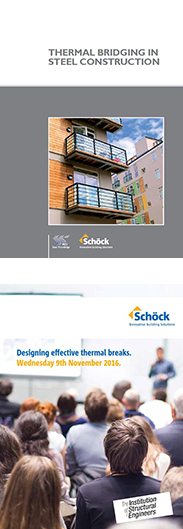
To coincide with the publication of P410, Schöck are holding a workshop at the Institution of Structural Engineers on Wednesday 9th November. The workshop is called "Designing Effective Thermal Breaks" and will cover thermal bridging in both steel and concrete construction. Attendance is free for those who register in advance. The publication was prepared by Andrew Way, Prof Mark Lawson and Dr Michael Sansom of The Steel Construction Institute with assistance from Dieter Hardock and Chris Willett of Schöck Ltd. Background thermal modelling was provided by Oxford Brookes University under an RFCS project TABASCO (contract RFSR-CT-00028). |
|
| |
SCI Releases explosion analysis software
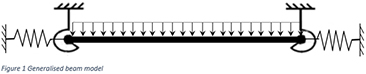
SCI has released the first module of a new software package that can be used to analyse steel structures subjected to dynamic loading (e.g. caused by an explosion). The first module is concerned with structural members and is based on single degree of freedom analysis with generalised boundary conditions as shown in Figure 1. Nonlinear material behaviour, catenary effects and strain rate effects can be accounted for in the analysis. A range of static and dynamic load combinations can be modelled. In the case of dynamic (explosion) loads, these can be specified as a generalised pressure-time history. The single degree of freedom model was compared against the nonlinear finite element analysis program Abaqus. The comparisons showed that the SDOF model achieves very good accuracy.
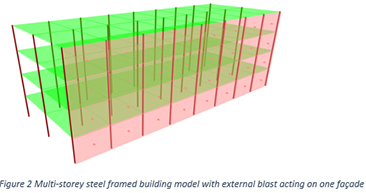
A second software module is due to be released in October. It will provide the capability to perform whole building analysis of steel framed buildings (Figure 2) against external blast load. The software will allow irregular floor grids as well as the removal of one or multiple columns at any level in the building. Both moment connections and bracing systems can be modelled to provide lateral resistance to the building. The blast load acting on the building façade can vary both spatially and temporally.
A third module will also follow shortly providing the facility to analyse composite floor slabs under blast loading.
The software can be accessed at: http://satel.staging.steel-sci.org/.
For further details, contact: Ibrahim Fahdah I.Fahdah@steel-sci.com.
|
|
| |
|
Presentations will include;
• Dry Film Thickness of Intumescent Coatings for Structural Steel Bracing Members
• Developments in TASEF
• Tensile Membrane Action of Composite Slabs in Fire – Are the Current Methods Really OK?
• The Future of EC2-1-2
• Cold-formed Steel Portal Frames in Fire
• Structural Fire resilience
• Challenges for Structural Fire Protection Strategies from Modular Construction
The forum discussions are based on all aspects of structures in fire, including project case studies, current research results, leading-edge issues, design code development.
If you would like to attend the next forum on the 5th September, or have topics for future forums, please contact David Rush. Visit the STIFF website
|
|
|
Supporting economic and innovative steel design in the UK
Tuesday 27th September 2016, ArcelorMittal Orbit, London.
At this ArcelorMittal and SCI event, a series of presentations will demonstrate why S460 was chosen for one of London’s newest iconic buildings and demonstrate how to specify, design and fabricate using S460 Steel. The event will also see the launch of the new ArcelorMittal Orange Book.
For more information click here.
To register for this event contact; scievents@steel-sci.com.
|

|
SCI Annual Event
3D Printing - the future of design and manufacture
Wednesday 9th November 2016, The National Gallery, London.
Presentations include;
• The MX3D bridge project in Amsterdam - Olivier Vassart, ArcelorMittal
• Additive Manufacture - Iain Todd, Sheffield University
• Simulation Driven Additive Manufacturing - New technology from SIMULIA-Abaqus – Auday Alrawe, Intrinsys
• Recent research projects from SCI
To attend contact education@steel-sci.com.
|

|
| |
SCI completes stainless steel Blind Bolt assessment
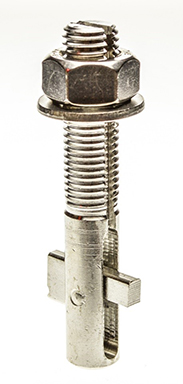
Following on from previous work with carbon steel bolts, SCI has just completed a test programme for the stainless steel equivalent. Bolts were tested in shear and in tension and design resistances determined following the procedures described in BS EN 1990-1 Annex D. As expected, the bolts ultimately fail in tension at the smallest cross section. The failure loads in both tension and shear were remarkably consistent, demonstrating accurate machining of the assembly and uniform material properties. In bearing, the behaviour of the supporting material is important, not the bolt, so there is no difference between the performance of carbon steel and stainless steel bolts. In common with any ‘blind’ fixing, the resistance of the supporting element must be verified, as the tension resistance reported is that of the bolt assembly alone. In the common application of connections to hollow sections, the strength or deformation of the relatively thin wall of the hollow section will be the weak link in the joint, not the bolt assembly.
The SCI report and design resistances are available from the Blind Bolt website, http://www.blindbolt.co.uk. |
|
| |
SCI People
Abdul Malik, Principal Engineer, Advisory Desk.
As the longest serving person at SCI, Abdul joined British Steel in 1972, and CONSTRADO in 1979 before transferring to SCI on its formation in 1986. What Abdul doesn’t know about steel means it is not worth knowing. You will speak to him if you call the SCI Advisory Desk, where he will provide an in-depth answer based on his vast knowledge of steel construction. He has provided technical input to many key design guides including; BS 5950 Pt 1, and the Eurocode version of the renowned SCI ‘Blue Book’ and the Green Book series, specialising in connection design. He sits on ECCTC10 for connections and has presented many SCI courses worldwide.
His pastime passion is cricket, having captained and played for over 50 years, his knowledge and association with the cricket world definitely rivals his knowledge of steel.
|
 |
| |
| |
SCI Publications |
.jpg) |
.jpg) |
 |
Design of composite highway bridges curved in plan (P393) This design guide addresses the consequences of the plan curvature on the design of composite bridges and effectively offers a supplement to SCI design guides P356 and P357. |
Fire resistance design of steel framed buildings (P375) This design guide provides a general overview of the fire design of steel and composite structures in accordance with the Eurocodes, introducing the basis of design for fire situations and the criteria that need to be met. |
Durability of Light Steel Framing in Residential Buildings (2nd Edition) P262 This publication presents a summary and analysis of research findings on the durability of galvanized cold formed steel used in housing; the results are used to calculate the predicted design life. |
|
|
|
|
|
| |
| |
SCI New Members
SCI would like to welcome the following new members:
TZG Partnership Ltd
|

|
| |
| |
SCI Members in the News
The Portakbin Group UK achieve construction industry first with new University Technical Centre contract
The Portakabin Group has been awarded the £14 million design and build contract for the UK’s first university technical college (UTC) to be built off site. Opening in September 2016, the Global Academy will provide academic and vocational training for 14-19 year olds who want to work in the broadcast and digital media industries
|

|
Lindapter launch ‘all-in-one’ steelwork clamp
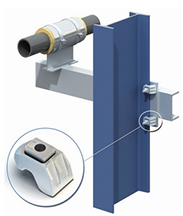
Lindapter, the inventor of the Girder Clamp and Hollo-Bolt has developed the Type AAF, a new steelwork clamp for connecting steel sections, offering adjustability, anti-corrosion protection and high load capacities, even in low temperature environments.
|
|
EOS Facades Shortlisted Four Times for the 2016 Offsite Construction Awards
The judges have spoken and the shortlist for this year’s Offsite Awards has been announced. The awards have seen fierce competition with a host of entries from high profile names, competing to be crowned as industry leaders of the offsite construction market.
|

|
| |
|
Be the first to demo the latest presentation and conferencing technology
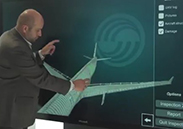
The giant Surface Hub is an infinite white board that makes presenting a pleasure and videoconferencing so simple. Manufacturers and designers are singing its praises.
You are invited to join Carillion Communications at Microsoft’s offices in Paddington for lunch and a hands-on demo.
Found out more and book
|
 |
| |
|
|
| |
| |
Twitter Suggestion
For course reminders, publication updates and article notifications follow SCI on Twitter.
|
Connect Sign Up |
Refer a friend or colleague who you think may be interested in receiving the SCI Connect Newsletter |
| CLICK TO REGISTER |
|
| |
© 2016. This newsletter has been published by The Steel Construction Institute Terms | Privacy Policy |
The Steel Construction Institute, Silwood Park, Ascot. SL5 7QN. Registered in England and Wales. Registered No: 1916698. We are limited by guarantee. |