In line with many other sectors, UK structural engineers' are facing up to the climate emergency and taking action; 170 organisations have already signed up to the Institution of Structural Engineers' declaration on the climate and biodiversity emergency.
The steel production and steel construction sectors have a significant role to play to help these organisations deliver on the commitments they have made.
Leading European steel makers have developed and embarked upon ambitious strategies to deliver low and zero-carbon steel by 2050 but the new technologies required, which include hydrogen reduction and carbon capture and storage, will take time and significant investment.
Easier and faster action can be taken by the steel construction supply chain by reducing the demand for steel while still delivering safe, high quality buildings. These actions generally relate to improving material efficiency through:
- Better and less conservative design
- Greater reuse of steel building components.
SCI has been a leading advocate of structural steel reuse and has recently completed its latest collaborative EU project on reuse called PROGRESS which focussed on single-storey, steel framed buildings which currently present the highest potential for reuse.
The scope of PROGRESS, which included secondary steelwork and metal cladding systems in addition to the primary structure, was split into the reuse of existing buildings and how to facilitate the future reuse of new buildings. This division reflects the challenges, and hence the solutions required, of each scenario.
Regarding existing buildings, workstreams included:
- Pre-deconstruction auditing and safe and efficient deconstruction practice
- The suitability of steel components reclaimed from existing buildings for reuse
- Sampling strategies and testing methods for reclaimed steel products.
A protocol recommending data collection, inspection and testing to ensure that reclaimed structural steelwork can be reused with confidence, has been developed by SCI (with financial support from Cleveland Steel & Tubes) and is freely available here.
Concerning design to facilitate future reuse, the work focussed on:
- How to design reusable single-storey steel frame buildings, systems and components to facilitate their future reuse including standardisation
- Development of innovative, demountable and reusable cladding systems
- The role of BIM to facilitate future reuse.
As part of the project SCI has developed a prototype on-line portal for trading reclaimed structural steelwork and for storing the relevant structural steel information (BIM datasets) from new buildings to facilitate their future reuse. SCI is keen to hear from any organisations who can help us commercialise this service.
PROGRESS also addressed other issues including the environmental and economic assessment of steel reuse and importantly what circular economy business models are required to facilitate mainstream reuse.
Dissemination was also a key part of PROGRESS and despite the cancellation of several of the final physical workshops due to the pandemic, SCI organised and hosted a series of webinars during May. All presentations are freely available from the ECCS website.
The design guidance from the PROGRESS project is being drafted as a comprehensive ECCS design guide which should be published later in 2020.
Many SCI members are signatories to the UK structural engineers climate emergency declaration and hopefully are thinking more about steel reuse and also benefitting from the guidance and expertise developed by SCI.
For more information please contact Michael Sansom
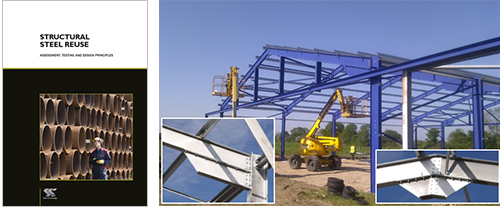
Left: Structural steel reuse protocol, SCI P427 | Right: Design to facilitate future reuse: bolted haunch and apex connections